Ge-ōl'o-gy, n.
n. [Fr. géologie; Gr. γῆ, the earth, and λόγος, discourse; λέγειν, to speak.] The science which treats of the structure and mineral constitution of the globe, the causes of its physical features, and its history.
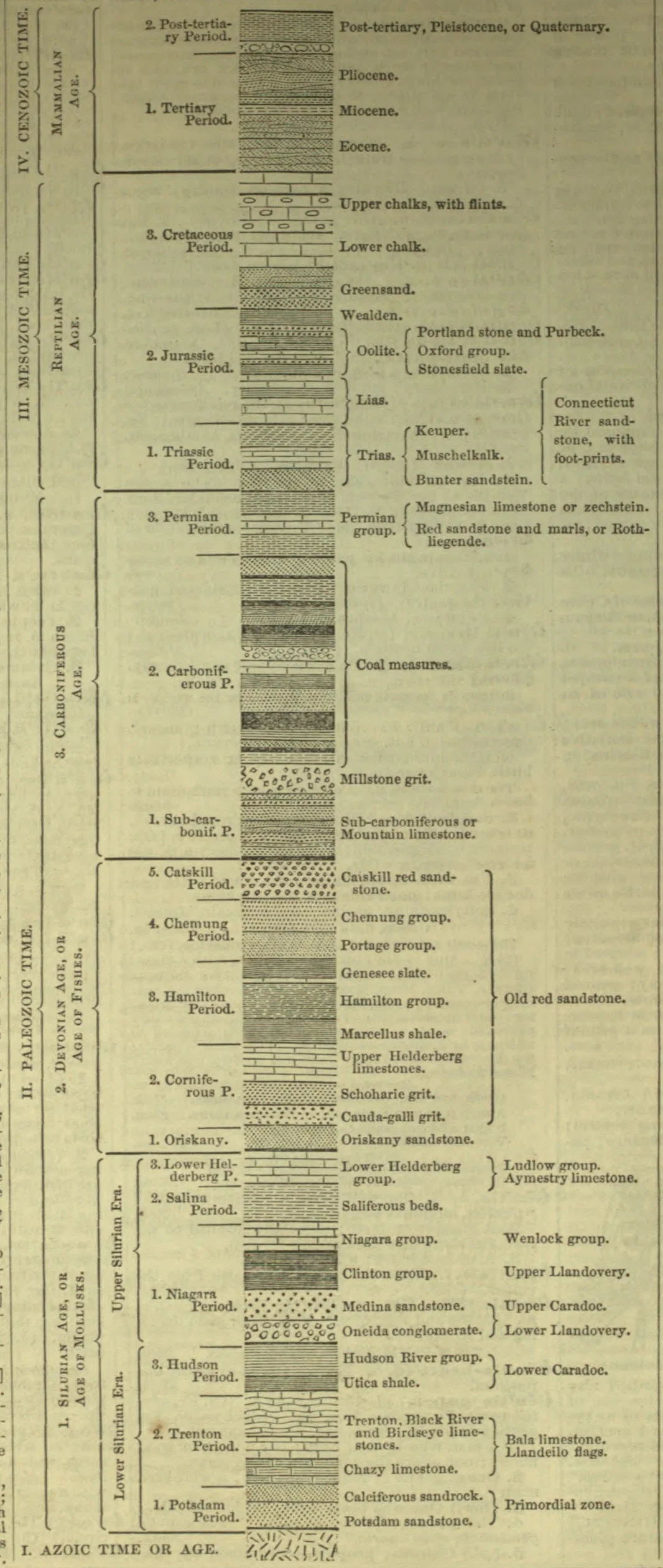
The science of geology, as treating of the physical history of the globe, involves a description of the different strata which compose its crust, their order of succession, characteristic forms of animal and vegetable life, &c. The principal subdivisions of geological time, and the most important strata corresponding to each, with their relative positions, are indicated in the following diagram:—
V. ERA OF MIND, OR AGE OF MAN.
The crystalline rocks, granite, mica slate, and the like, once called primitive, and regarded as situated beneath all other rocks, are now known not to be exclusively of any particular age. Those of Northern New York and Northern Canada are of the Azoic age; those of the larger part of New England are Paleozoic rocks, but date their crystallization from the close of the Paleozoic era; others, of the Alps, are still more recent in origin. Dana.