Goose, n.
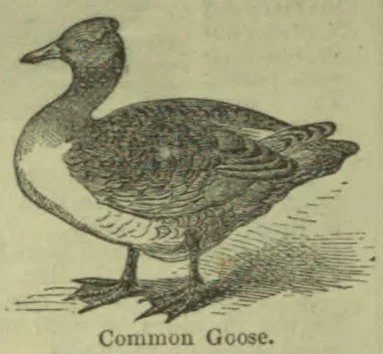
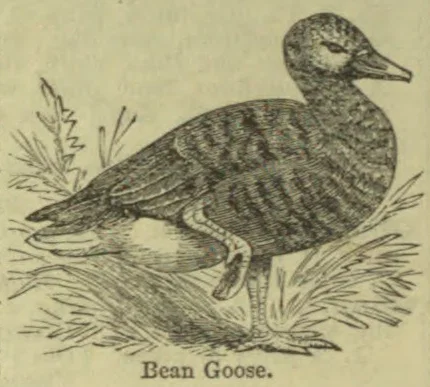
n.; pl. GEESE. [A-S. gōs, Icel. gās, Dan. gaas, Sw. gås, Ger. gans, allied to Armor. gwaz, garrz, W. gwyd(d), Ir. geadh, Lat. anser, for han-ser, Gr. χήν, Slav. gǫsi and gonsi, Bo-hem. hus, Skr. hang-sa. Pliny says that, in Germany, the small, white geese were called ganzæ, al. gantae, lib. x. 22.] 1. (Ornith.) An aquatic fowl, of the genus Anser. The common goose lives chiefly on land, and feeds on grass; it is supposed to be the wild goose domesticated. The soft feathers are used for beds, and the quills for pens. The wild goose is migratory. Barnacle goose, the Anser bernicle; — so called from the notion formerly entertained that it was developed from a barnacle. — Bean goose, the Anser segetum of Gmelin, by some considered a distinct species, and by others a mere variety of wild goose. — Green goose (Cookery), a goose less than four months old.
- A tailor’s smoothing-iron, so called from its handle, which resembles the neck of a goose.
- A silly creature; a simpleton.
- A game of chance, formerly common in England.
☞ It was played on a card divided into small compartments numbered from 1 to 63, arranged in a spiral figure around a central open space, on which, at the beginning of the game, the stakes are laid, and during the game any forfeits paid. It was played by two or more persons with two dice, and the numbers that turned up to each designated the number of the compartment on which he might place his mark or counter. It was called the game of goose, because at every fourth and fifth compartment in succession, a goose was depicted on the card, and if the throw of the dice carried the counter of a player on a goose, he might move forward double the actual number thrown. Strutt. The royal game of goose was there to view. Goldsmith.