Gōv'ern-or, n.
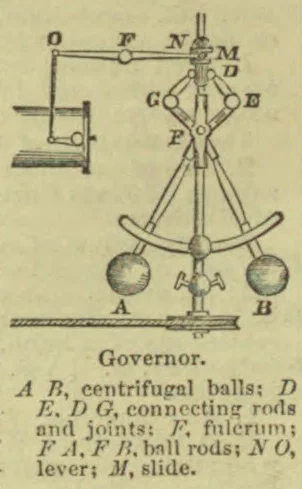
(gŏv'ern-ur), n. [Fr. gouverneur, Pr. gouvernaire, gobernador, Sp. gobernador, Pg. governador, It. governatore, Lat. gubernator.] One who governs; especially, (a.) One who is invested with supreme authority in the state; a chief ruler or magistrate; as, the governor of Pennsylvania. (b.) One who has the care or guardianship of a young man; a tutor; a guardian. (c.) (Naut.) A pilot; one who steers a ship. [Rare.] (d.) (Mach.) A contrivance connected with mills, steam-engines, or other machinery, for maintaining uniform velocity with a varying resistance. The most common form of governor used in the steam-engine consists of two centrifugal balls, the arms supporting which are connected by joints with a revolving spindle, and have their upper extremities connected by means of a slide upon the spindle, with a lever which opens or shuts the throttle-valve as the greater or less speed of the engine causes the balls to rise or fall, thus regulating the supply of steam according to the amount of resistance to be overcome.
Governor. A B, centrifugal balls; D E, D G, connecting rods and joints; F, fulcrum; A F, F B, ball rods; N O, lever; M, slide.
Hydraulic governor, or cataract, a contrivance applied to Cornish engines for regulating the number of strokes per minute, by means of water raised by a pump at each stroke of the engine, and forced by counter-weights through a cock, causing a system of levers to act on the proper valves. — Silver's momentum-wheel governor, a form of governor for marine engines, in which the throttle-valve is connected by suitable mechanism with a heavy revolving wheel, the momentum of which causes it to act upon the valve whenever there is a change of velocity in the engine.