Heärt1, n.
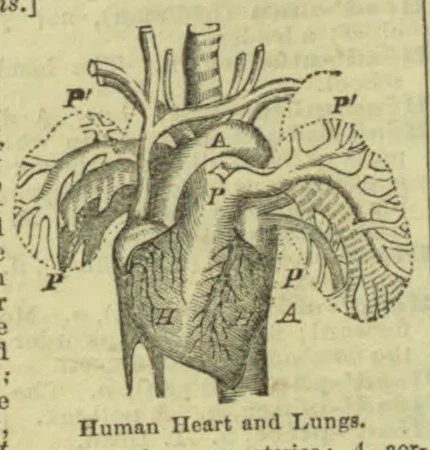
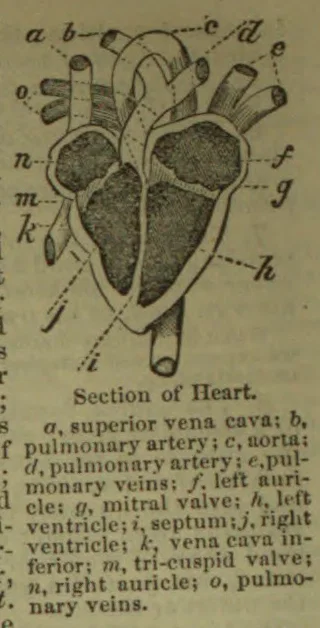
(härt), n. [A.-S. heorte, O. Sax. herta, O. Fries. herte, hirte, D. hart, Icel. hiarta, Sw. hjerta, Dan. hierte, Goth. hairtô, O. H. Ger. herzâ, M. H. Ger. herze, N. H. Ger. herz, allied to Lat. cor, cordis, Gr. καρδία, κῆρ, κέρας, Skr. hrid, Slav. srŭd’ze, Russ. serdze, Lith. szirdis.] 1. (Anat.) A hollow, muscular organ, contracting rhythmically, and serving to keep up the circulation of the blood. In man, it has four chambers. The blood passes from the veins of the system into the upper chamber on the right side, called the right auricle; thence, into the chamber below, called the right ventricle. Between these is the tricuspid valve, which closes when the heart contracts, and the blood is sent from the right ventricle to the lungs. It is returned to the left upper chamber (the left auricle), passes thence into the left ventricle, is prevented from returning into the auricle by the mitral valve, which closing when the ventricle contracts, the blood is driven into the arteries of the body.
Human Heart and Lungs. P P P, pulmonary arteries; A, aorta; H H, right and left ventricle; P′ P′, pulmonary veins.
The lymphatic hearts of reptiles are contractile sacs which pump the lymph into the veins.
Why does my blood thus muster to my heart? Shak.
Sense 2. The seat of the affections or sensibilities, collectively or separately, as love, hate, joy, grief, courage, and the like; rarely, the seat of the understanding or will;—usually, in a good sense, when no epithet is expressed; the better or lovelier part of our nature; the spring of all our actions and purposes; the seat of moral life and character; the moral affections and character itself; the individual disposition and character; as, a good, tender, loving, bad, or selfish heart.
Section of Heart. a, superior vena cava; b, pulmonary artery; c, aorta; d, pulmonary artery; e, pulmonary veins; f, left auricle; g, mitral valve; h, left ventricle; i, septum; j, right ventricle; k, vena cava inferior; m, tri-cuspid valve; n, right auricle; o, pulmonary veins.
Sense 3. The part nearest the middle or center; the part most hidden and within; the inmost or most essential part of any body or system; the source of life and motion in any organization; the chief or vital portion; the center of activity, or of energetic or efficient action; as, the heart of a country, tree, &c. “Exploits done in the heart of France.” Shak.
Peace subsisting at the heart Of endless agitation. Wordsworth.
Sense 4. Courage; courageous purpose; spirit. “Eve, recovering heart, replied.” Milton.
The expelled nations take heart, and when they fly from one country invade another. Temple.
Sense 5. Vigorous and efficient activity; power of fertile production; the condition of the soil, whether good or bad. “That the spent earth may gather heart again.” Dryden.
Sense 6. That which resembles a heart in shape; especially a roundish or oval figure having an obtuse point at one end, and at the other a corresponding indentation, and used as a symbol or representative of the heart; hence, one of a series of playing-cards, distinguished by that figure; as, hearts are trumps.
Sense 7. Secret meaning; real intention.
And then show you the heart of my message. Shak.
At heart, in the true character or disposition; as regards the heart; really; substantially; as, he is at heart a good man.—By heart, in the closest or most thorough manner; as, to know or learn by heart. “Composing songs for fools to get by heart.” Pope.—For my heart, for my life; if my life was at stake. “I could not get him for my heart to do it.” Shak.—Hardness of heart, cruelty; want of sensibility.—To break the heart of. (a.) To bring to despair or hopeless grief; to cause to be utterly cast down by sorrow. (b.) To bring almost to completion; to finish very nearly;—said of any thing undertaken; as, he has broken the heart of the task.—To find in the heart, to be willing or disposed. “I find it in my heart to ask your pardon.” Sidney.—To have in the heart, to purpose; to have design or intention.—To have the heart in a nutshell, to be very penurious, mean-spirited, or cowardly.—To have the heart in the mouth, to be much frightened.—To heart, to the inmost affections; as, to take to heart, that is, to grieve over, to be concerned about.—To set the heart at rest, to put one's self at ease.—To set the heart upon, to fix the desires on; to long for earnestly; to be very fond of.—To speak to one's heart (Script.), to speak kindly to; to comfort; to encourage.
Heart is used in many compounds, the most of which need no special explanation; as, heart-aching, heart-affecting, heart-alluring, heart-appalling, heart-breaking, heart-bred, heart-buried, heart-cheering, heart-chilled, heart-consuming, heart-corroding, heart-devouring, heart-discouraging, heart-easing, heart-expanding, heart-felt, heart-grinding, heart-hardened, heart-hardening, heart-hatred, heart-hearing, heart-humbled, heart-offending, heart-piercing, heart-purifying, heart-quelling, heart-rending, heart-searching, heart-sinking, heart-sore, heart-sorrowing, heart-thrilling, heart-touching, heart-wounding, and the like.