3 entries under this word

Helm

Hĕlm, n.

noun

n. [A-S. helma, healma, rudder, D. & N. H. Ger. helm, helve, handle, and a rudder, helm, Prov. Ger. helbm for helben, M. H. Ger. halm, helve, handle. Cf. HELVE.]

  1. (Naut.) The instrument by which a ship is steered, consisting of a rudder, a tiller, and, in large vessels, a wheel.
  2. The place of direction or management; as, to be at the helm in the administration.
  3. A helve. [Obs.]

A great ax first she gave, that two ways cut, In which a fair, well-polished helm was put. Chapman. 4. The stem or stalk of grain. See HAULM.
Hĕlm, v. t.

verbtransitive

v. t. 1. To steer; to guide; to direct. [Obs.] The very stream of life, and the business he hath helmed, must give him a better proclamation. Shak. 2. To cover with a hemlet. The helmed cherubim Are seen in glittering ranks. Milton.

Hĕlm or Hĕlm'et, n.

noun

n. [A-S., O. Sax., D., & Ger. helm, Goth. hilms, Icel. hiâlmr, Dan. & Sw. hielm, from A-S. & O. H. Ger. helan, to hide, to hele; allied to Lith. szalmas, Slav. shljem, Russ. shlem; whence O. Fr. healme, halme, elme, N. Fr. heaume, Pr. elm, It., Pg., & O. Sp. elmo, N. Sp. yelmo; O. Fr. healmet, Sp. & Pg. almete, for elmete.]

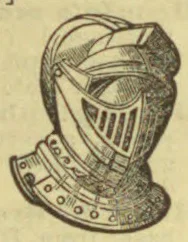
  1. Defensive armor for the head; a head-piece; a morion.
  2. That which resembles a helmet in form, position, &c.; as, (a.) The upper part of a retort. Boyle. (b.) The hood-formed upper sepal of some flowers, as of the snap-dragon. (c.) A heavy cloud lying on the brow of a mountain. [Prov. Eng.]

Halliwell. 3. (Her.) The representation of a helmet over shields or coats of arms, denoting, by modifications of form, gradations of rank.

An engraved medieval helmet with a visor and a decorated neck guard.