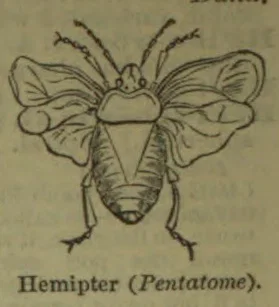
He-mip'ter or He-mip'ter-an, n.
n. [Gr. ἡμι, half, and πτερόν, feather, wing, from πέτομαι, πέτεσθαι, to fly; Fr. hémiptères, pl.] (Entom.) One of that order of insects having the anterior wings or wing-covers transparent toward the end, the true wings straight and unplaited, and feeding on vegetable or animal juices by means of a sucking-tube.
There are two groups of these: 1. The true hemipterans (Hemiptera heteroptera), in which the wing-covers are opaque at the base, and overlap at their transparent tips, as the various bugs. 2. Those (H. homoptera) in which the wing-covers are of one texture throughout, and more or less transverse, and do not overlap when shut; as, the harvest-flies, plant-lice, &c. By some authors the order Hemiptera is replaced by the two groups, Heteroptera and Homoptera, which are raised to the rank of orders.