Hĕr'mēs, n.
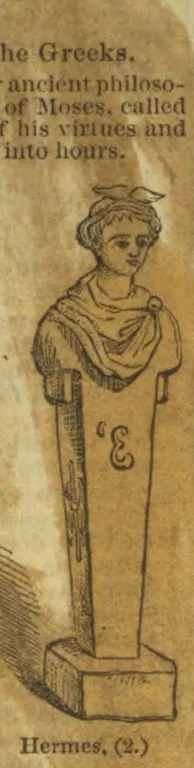
n. [Gr. Ἑρμῆς, Mercury.] 1. (Myth.) Mercury, so called by the Greeks. ☞ The name is also applied to a very ancient philosopher, who appeared soon after the time of Moses, called Trismegistus (thrice great), by reason of his virtues and great learning. He first divided the day into hours. 2. (Archæology.) A rough, quadrangular stone or pillar, having a head, usually of Hermes, or Mercury, sculptured on the top, without arms or body, placed by the Greeks in front of buildings, and used by the Romans as boundaries or landmarks. [Written also Herma.]