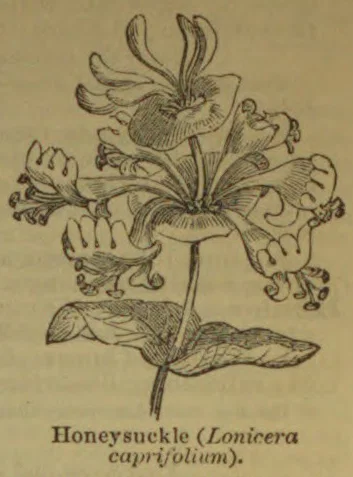
Hon'ey-sŭck/le, n.
(hŭn'y-sŭk'l), n. (Bot.) One of several species of flowering plants, much admired for their beauty, and some for their fragrance.
The Lonicera periclymenum bears yellow fragrant flowers and red berries: it is found in Europe and is the true English woodbine, called by Milton “twisted eglantine.” The trumpet-honeysuckle is the L. sempervirens: its flowers are of a bright scarlet without and yellowish within, and are scentless: it is common in the United States. The American woodbine, L. grata, is fragrant, and found from New York westward, especially in rocky places. The European fly-honeysuckle is L. xylosteum; the American, L. ciliata. The false honeysuckle is the Azalea, common in our swamps. The name honeysuckle is said to be derived from the practice by children of sucking the corolla to obtain the drop of sweet juice at its base.