Hōrse1, n.
n. [A.-S. hors, for hros, O. Sax., Icel., & O. H. Ger. hros, N. H. Ger. ross, M. H. Ger. & D. ros; whence Pr. ros, O. Fr. rous, a horse, Pr. rosse, Fr. rosse, It. rozza, a sorry horse, jade. Cf. Skr. hrēsh, to neigh.]
Sense 1. (Zoöl.) A hoofed quadruped of the genus Equus (E. caballus), having one toe to each foot, a mane, and a long, flowing tail. It is exclusively herbivorous, having six broad grinding teeth on each side of each jaw; and six incisors and two canine teeth both above and below. The mares have the canines rudimentary or entirely wanting. It has all four legs furnished with warts, or castors, which distinguishes it from the ass. It is supposed to be originally a native of Central Asia. The horse excels in strength, speed, docility, courage, and nobleness of character, and is used for drawing, carrying, bearing a rider, and like purposes.
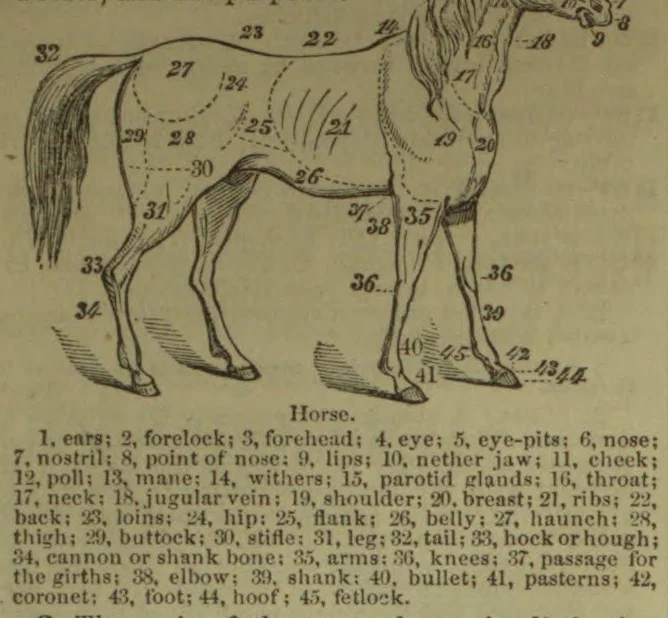
Horse.
1, ears; 2, forelock; 3, forehead; 4, eye; 5, eye-pits; 6, nose; 7, nostril; 8, point of nose; 9, lips; 10, nether jaw; 11, cheek; 12, poll; 13, mane; 14, withers; 15, parotid glands; 16, throat; 17, neck; 18, jugular vein; 19, shoulder; 20, breast; 21, ribs; 22, back; 23, loins; 24, hip; 25, flank; 26, belly; 27, haunch; 28, thigh; 29, buttock; 30, stifle; 31, leg; 32, tail; 33, hock or hough; 34, cannon or shank bone; 35, arms; 36, knees; 37, passage for the girths; 38, elbow; 39, shank; 40, bullet; 41, pasterns; 42, coronet; 43, foot; 44, hoof; 45, fetlock.
Sense 2. The male of the genus horse, in distinction from the female.
Sense 3. Mounted soldiery; troops serving on horseback; cavalry;—used without the plural termination; as, a regiment of horse.
Sense 4. A frame with legs used for supporting something; as a clothes-horse, a saw-horse, and the like.
Sense 5. A frame of timber, &c., on which soldiers are made to ride for punishment.
Sense 6. (Mining.) A mass of earthy matter or other wall-work inclosed between branches of a vein, as of coal, ore, &c.; hence, to take horse—said of a vein—is to divide into branches for a distance.
Sense 7. (Naut.) (a.) A foot-rope extending from the middle of a yard to its extremity, to support the sailors while they loose, reef, or furl the sails. (b.) A thick rope extended near the mast for hoisting a yard or extending a sail on it. Totten.
To take horse. (a.) To set out to ride on horseback. (b.) To be covered, as a mare. (c.) See No. 6, supra.