Hy-drau'lic or Hy-drau'lic-al, a.
a. [Fr. hydraulique, Lat. hydraulicus, Gr. ὑδραυλικός, from Lat. hydraulus, Gr. ὕδραυλις, or ὕδραυλος, a water-organ, from ὕδωρ, water, and αὐλός, flute, pipe.] Pertaining to hydraulics, or to fluids in motion.
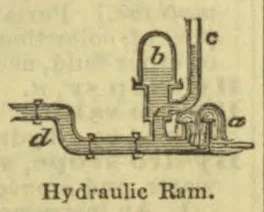
Hydraulic cement, a cement or mortar made of hydraulic lime, to be used under water. — Hydraulic crane, a crane operated by the pressure of water. — Hydraulic lime, a mixture producing an insoluble silicate of alumina, composed partly of lime, which hardens in water, and is used for cementing under water. — Hydraulic press. See HYDROSTATIC. — Hydraulic ram, a machine for raising water by means of the momentum or moving force of the water of which a portion is to be raised. When the rush of water through the main pipe d, shuts the valve at a, the momentum of the current thus suddenly checked forces part of it into the air-chamber b, and up the pipe c, its return being prevented by a valve below, while the dropping of the valve a by its own weight allows another rush through the main pipe, and so on alternately.