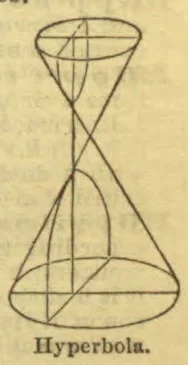
Hȳ-pĕr'bo-lă, n.
n. [Gr. ὑπερβολὴ, overshooting, excess, from ὑπερβάλλειν, to throw over or beyond, from ὑπέρ, over, beyond, and βάλλειν, to throw; Fr. hyperbole.] (Geom.) A curve formed by a section of a cone, when the cutting-plane makes a greater angle with the base than the side of the cone makes; a plane curve such that the difference of the distances from any point of it to two fixed points, called foci, is equal to a given distance, which is the nearest distance between the two branches of the curve. If the cutting-plane be produced so as to cut the opposite cone, another curve will be formed, which is also an hyperbola; or both curves may be regarded as branches of the same hyperbola. Math. Dict.