In'sect1, n.
n. [Lat. insectum, from insectus, p. p. of insecare, to cut in; Fr. insecte, Sp. insecto, It. insetto. This name seems to have been originally given to certain small animals, whose bodies appear cut in, or almost divided. So in Greek ἔντομον, sc. ζῷον.]
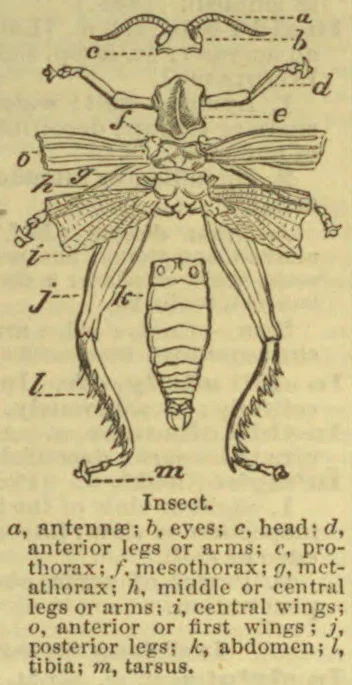
Sense 1. (Zool.) An articulate animal that in its mature state has the body divided into three distinct parts, the head, the thorax, and the abdomen, has six legs, never more than four wings, and that breathes air through the body in tubes opening externally by spiracles. Insects leave the egg as caterpillars or grubs, which are called larvæ. The higher insects undergo a metamorphosis in which the larvæ incloses itself in a cocoon or shell, and is then called the chrysalis or pupa. After remaining torpid in this shell for a time, it breaks forth as the perfect winged insect, or imago.
Sense 2. Any thing small or contemptible. Thomson.
Insect. After re- a, antennæ; b, eyes; c, head; d, anterior legs or arms; e, prothorax; f, mesothorax; g, metathorax; h, middle or central legs or arms; i, central wings; o, anterior or first wings; j, posterior legs; k, abdomen; l, tibia; m, tarsus.
Insects are generally divided as follows:—
I. Those having jaws: 1. Coleoptera, having four wings, the anterior pair horny or leathery, and when closed, joined by a straight suture, and covering the posterior pair; they undergo a metamorphosis with a torpid pupa, as the beetles. 2. Orthoptera (including Euplexoptera), having four wings, the anterior leathery, when closed not covering the posterior, and usually overlapping at the tip, the posterior pair folded like a fan; they undergo a metamorphosis by molting in an active pupa state; as the earwigs, grasshoppers, crickets. 3. Thysanoptera, having four membranous wings without nervures or veining, but set with cilia about the rim. 4. Neuroptera, having four equal, membranous, closely-veined wings, the posterior pair not folded; as the May-fly, dragon-fly. 5. Trichoptera, having four hairy, membranous wings, of which the posterior are the larger; they undergo a metamorphosis with an inactive pupa; as the caddis-flies. 6. Hymenoptera, having four loosely-veined, membranous wings, the posterior pair being the smaller, and hooked to the anterior in flight; as the bees, wasps, hornets, ants. 7. Strepsiptera, having the anterior pair of wings mere twisted appendages, and the posterior folding like a fan. These are mostly parasitic on bees and other hymenopterous insects.
II. Insects having sucking tubes: 8. Lepidoptera, having four extended membranous wings covered with minute scales, that ordinarily appear like a fine dust; as the butterflies, moths, and the like. 9. Homoptera, having membranous wings, the posterior pair the smaller, but not overlapping; as the cicadas, the froghoppers, the plant-lice, the cochineal bug. 10. Heteroptera, having four partly membranous wings, the posterior pair the smaller, and overlapping at the tip; as the water-beetles, the whirligigs or skippers, the bed-bugs. 11. Aphaniptera, having four rudiments of wings in the form of minute scales; as the flea, the louse. 12. Diptera, having two membranous, veined, anterior wings, and two balancers; as the flies, the gnats, the mosquitoes, the midges.
By many authors the two groups Homoptera and Heteroptera are placed as subdivisions of another group, the Hemiptera, which takes the place of these two in classification.