I'ris, n.
(89), n. Eng. pl. I'RIS-ES; Lat. pl. IR'I-DĒS. [Lat. iris, iridis, Gr. ἶρις, ἴριδος, the rainbow.
- The rainbow.
- An appearance resembling the rainbow.
- (Anat.) A membrane stretched vertically at the anterior part of the eye in the midst of the aqueous humor, and perforated by a circular opening called the pupil.
¶ As seen from the front, the iris is the colored ring which surrounds the pupil, and by the dilatation or contraction of whose fibers the size of the pupil is varied. Its use seems to be to regulate the quantity of luminous rays necessary for distinct vision. The color of the iris gives that of the eye. Dunglison.
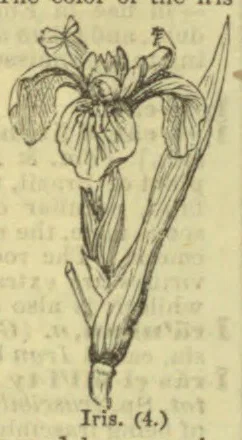
- (Bot.) A genus of bulbous or tuberous rooted plants, of which the flower-de-luce (fleur-de-lis), orris, and other species of flag, are examples.
- (Her.) A bearing; — the same as FLEUR-DE-LIS, q. v.