3 entries under this word

Keel

Keel, v. t.

verbtransitive

[Sax. cælan, to cool.] To cool. [Obs.] “While greasy Joan doth keel the pot.” Shak. “To lessen and keel the affections of the subject.” Milton.

Keel, n.

noun

[A-S. ceol, O. H. Ger. kiol, N. H. Ger., L. Ger., & D. kiel, Icel. kiö́lr, kiöll, Sw. köl, Dan. kiöl, whence Fr. quille, Sp. quilla, Pg. quilha, It. chiglia, chiela.]

  1. (Ship-building.) The principal timber in a ship, extending from stem to stern at the bottom, and supporting the whole frame; hence, a ship. [See Illustr. of Keelson.]
  2. (Iron Ship-building.) A structure of plates, &c., situated like the keel of a timber ship; but many iron ships have no keels.
  3. A low, flat-bottomed vessel, used in the River Tyne to convey coals from Newcastle for loading the colliers.
  4. A broad, flat vessel, used for cooling liquids, as in a brewery; a keeler. Nares.
  5. A nine-pine. See KAYLE.
  6. (Bot.) The two lowest petals of the corolla of a papilionaceous flower inclosing the stamens and pistil.
  7. (Nat. Hist.) A projecting ridge along the middle of a flat or curving surface. Henslow.

False keel (Naut.), a strong, thick piece of timber, bolted to the bottom of the keel, to preserve it from injury.—On an even keel, in a level or horizontal position.
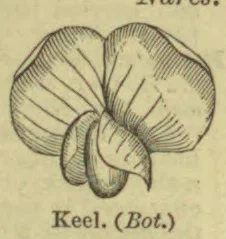
A botanical illustration of a flower showing its keel-shaped petals.
Keel. (Bot.)

Keel, v. i.

verbintransitive

[imp. & p. p. KEELED; p. pr. & vb. n. KEELING.] [A-S. cêlan, O. H. Ger. chiolan, M. H. Ger. küelen, N. H. Ger. kühlen. See COOL.]

  1. To plow with a keel; to navigate. J. Barlow.
  2. To turn up the keel; to show the bottom. Shak.