n. [Allied to lath, a narrow board. Cf. Ger. drechselbank, a turning-lathe, literally, a turning-bench.]
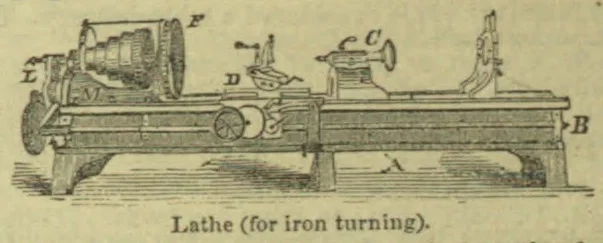
- (Mach.) A machine-tool for shaping articles of wood, metal, or other material, by causing them to revolve while acted upon by a cutting-tool held either by the hand or a slide-rest; — called also turning-lathe.
- The movable swing-frame of a loom, carrying the reed for separating the warp-threads and beating up the weft; — called also lay and batten.
Blanchard's lathe, a lathe for turning irregular forms after a given pattern, as lasts, gun-stocks, and the like. — Engine-lathe, or turning-engine (called, among machinists, a lathe), a machine-tool having an automatic feed, and used chiefly for turning metals, cutting screws, and often for boring. Upon the shears, or framing, A, stand the fixed head-stock, M, (which carries the spindle and face-plate, F), the movable tail-stock, C, and the compound-rest, D, which is moved longitudinally by the lead-screw, B, actuated by the feed, L, and upon which stand the tool-stock and tool-rest. — Foot-lathe, a lathe which is driven by a treadle worked by the foot. — Hand-lathe, a lathe which has no automatic feed. — Throw-lathe, a small lathe worked by one hand, while the cutting-tool is held in the other. — Rose-engine lathe. See ROSE-ENGINE.