Lēns, n.
n.; pl. LENS'ES. [Lat. lens, lentil, on account of the resemblance of shape to the seed of a lentil.] (Opt.) A piece of glass, or other transparent substance, ground with two opposite regular surfaces, either both curved, or one curved and the other plane, and commonly used, either singly or combined, in optical instruments for changing the direction of rays of light, and thus magnifying objects, or otherwise modifying vision. In practice, the curved surfaces are usually spherical, though rarely cylindrical, or of some other figure.
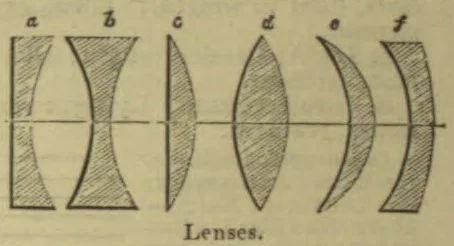
☞ Of spherical lenses, there are six varieties, as shown in section in the figures, viz., a, plano-concave; b, double-concave; c, plano-convex; d, double-convex; e, meniscus; f, concavo-convex.
Crossed lens, a double-convex lens with one radius equal to six times the other. — Crystalline lens (Anal.). See CRYSTALLINE and EYE. — Multiplying lens, or glass, a lens one side of which is plane and the other convex, but made up of a number of plane faces inclined to one another, each of which presents a separate image of the object viewed through it, so that the object is, as it were, multiplied. — Polyzonal lens. See POLYZONAL.