Lē'ver or Lēv'er1, n.
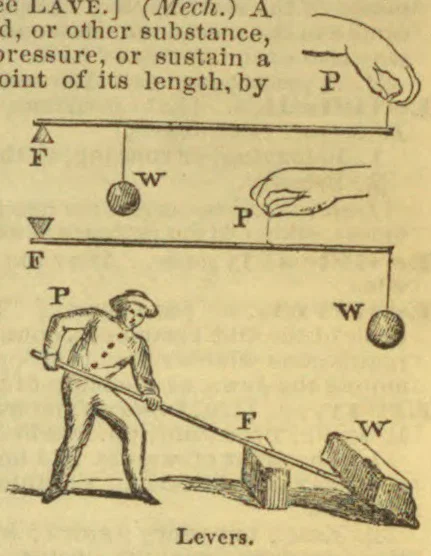
n. [Fr. levier, from lever, to raise; It. leva. See LAVE.] (Mech.) A bar of metal, wood, or other substance, used to exert a pressure, or sustain a weight, at one point of its length, by receiving a force or power at a second, and turning at a third on a fixed point called a fulcrum. It is usually named as the first of the six mechanical powers, and is of three kinds, according as either the fulcrum F, the weight W, or the power P, respectively, is situated between the other two, as in the figures.
Levers.
Lever watch, a watch having a vibrating lever to connect the action of the escape-wheel with that of the balance. — Universal lever, a machine formed by a combination of a lever with the wheel and axle, in such a manner as to convert the reciprocating motion of the lever into a continued rectilinear motion of some body to which the power is applied. Brande.