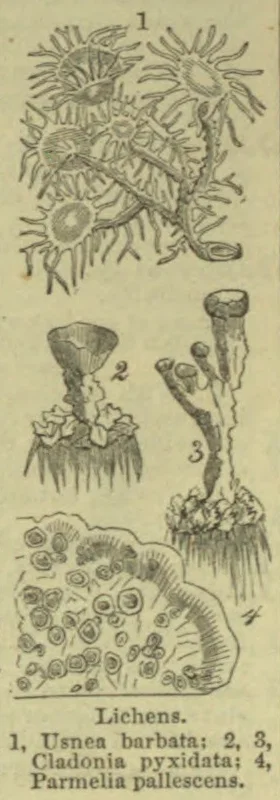
Lī'chen, n.
(lī'ken, or līch'en), n. [Lat. & Fr., Gr. λειχήν, Sp. líquen, It. lichene.]
- (Bot.) One of an order of cellular, flowerless plants, having no distinction of leaf and stem, usually of scaly, expanded, frond-like forms, but sometimes imitating the forms of branches of trees. They derive their nourishment from the air, and generate by means of spores. The species are very widely distributed, and form irregular spots or patches, usually of a greenish or yellowish color, upon rocks, trees, and various bodies, to which they adhere with great tenacity. They are often improperly called rock-moss, or tree-moss.
- (Med.) A cutaneous eruption, attended with tingling and pricking. It usually terminates with resolution or desquamation, but sometimes by superficial ulceration, and is not contagious.
Lichen acid, or lichenic acid (Chem.), an acid obtained from lichens, by the decomposition of which a substance is produced which absorbs oxygen and becomes a dye. Miller. ☞ As a medical word, Smart pronounces it lī'ken, but as a botanical term, līch'en.