7 entries under this word

Light

Light, n.

noun

(līt), n. [A-S. leóht, lyht, O. Sax. lioht, leoht, liaht, Goth. liuhath, O. H. Ger. lioht, leoht, M. H. Ger. lieht, N. H. Ger. & D. licht, from Goth. liuhan, equivalent to Lat. lucere.]

Sense 1. That agent or force in nature by the action of which upon the organs of sight, objects from which it proceeds are rendered visible; regarded formerly as consisting of material particles, or corpuscules, sent off in all directions from luminous bodies, and traversing space, in right lines, with the known velocity of 192,000 miles per second; but now generally considered by men of science as consisting, not in any actual transmission of particles or substance, but in the propagation of vibrations or undulations in a subtile, elastic medium, or ether, assumed to pervade all space, and to be thus set in vibratory motion by the action of luminous bodies, as the atmosphere is by sonorous bodies. This latter, or the now prevalent, view of the nature of light, is known as the undulatory or wave theory; the other, advocated by Newton, as the corpuscular, emission, or Newtonian theory.

Solar Ray of Light, separated by a prism into the seven primary colors. a, prism; c d, spectrum; v, violet; i, indigo; b, blue; g, green; y, yellow; o, orange; r, red.

Sense 2. The source of the illuminating medium; that which gives light, or renders objects distinct, as the sun, a star, a candle, a light-house, and the like.

Then he called for a light, and sprang in. Acts xvi. 2.

And God made two great lights; the greater light to rule the day, and the lesser light to rule the night. Gen. i. 16.

Sense 3. The medium through which light is admitted, as a window, or window-pane, a sky-light.

There were windows in three rows, and light was against light in three ranks. 1 Kings vii. 4.

Sense 4. Life; existence.

O, spring to light! auspicious Babe, be born! Pope.

Sense 5. A division or space in a window-frame for a single pane of glass; hence, also, a pane of glass.

Sense 6. That which illumines or makes clear to the intellect; hence, also, mental or spiritual illumination; the assent, conviction, or instruction of the intellect; enlightenment; instruction; knowledge; information; especially, the source of moral or religious enlightenment.

He shall never know That I had any light of this from thee. Shak.

Sense 7. Day; especially the dawn of day.

The murderer, rising with the light, killeth the poor and needy. Job xxiv. 14.

Sense 8. Open view; a visible state or condition; public observation; publicity.

Why am I asked, What next shall see the light? Pope.

Sense 9. A time of prosperity and happiness; joy; felicity.

Then shall thy light break forth as the morning. Isa. lviii. 8.

Sense 10. (Paint.) The manner in which the light strikes upon a picture; also, the illuminated part of a picture; the part which lies opposite to the luminary by which the piece is supposed to be enlightened, and is painted in vivid colors; — opposed to shade.

Sense 11. The point of view or position in which any thing is seen, or from which instruction or illustration is supposed to be derived.

An author who has not learned the art of ranging his thoughts and setting them in proper lights, will lose himself in confusion. Addison.

Sense 12. One who is conspicuous or noteworthy; a model or example; as, the lights of the age or of antiquity.

☞ Light is used figuratively to denote that which resembles physical light in any respect, as illuminating, benefitting, or enlivening mankind.

Ancient lights (Law), window lights, which have been opened and enjoyed without molestation, and have become established by the legal time of prescription. Kent. Bouvier. — Northern light, or lights. See AURORA. — To come to light, to be detected; to be discovered or found. — The light of the countenance, favor; smiles. “Lord, lift thou up the light of thy countenance upon us.” Ps. iv. 6. — To stand in one’s own light, to be the means of preventing one’s good, or frustrating one’s own purposes.
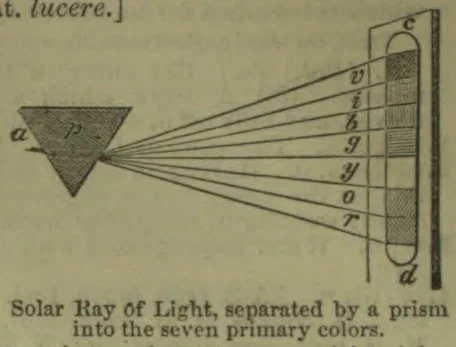
A prism separates a beam of solar light into seven colored rays shown on a vertical screen.
Solar Ray of Light, separated by a prism into the seven primary colors.

Light (lĭt), a.

adjective

(lĭt), a. [comp. LIGHTER; superl. LIGHTEST.]

  1. Not dark or obscure; bright; clear; as, the morning is light: the apartment is light.
  2. White or whitish; not intense or very marked; moderately colored; as, a light color; a light brown; a light complexion.

Līght, a.

adjective

(līt), a. [comp. LIGHTER; superl. LIGHTEST.] [A-S. līht, leóht, lêht, O. H. Ger. lîhti, M. H. Ger. lihte, D. ligt, N. H. Ger. leicht, Icel. lettr, Dan. let, Sw. lätt, Goth. leihts, lightness; allied to Skr. laghu, Gr. ἐλαχύς, Lat. levis.]

Sense 1. Having little weight; not tending to the center of gravity with force; not heavy.

The weights did not exert their natural gravity, . . . insomuch that I could not guess which was light or heavy, whilst I held them in my hand. Addison.

Sense 2. Not burdensome; easy to be lifted, borne, or carried by physical strength; as, a light burden, weight, or load.

It will be light, that you may bear it Under a cloak. Shak.

Sense 3. Easy to be suffered or performed; not difficult; as, a light affliction or task.

Light sufferings give us leisure to complain. Dryden.

Sense 4. Easy to be digested; not oppressive to the stomach; as, light food; also, containing little nutriment.

Sense 5. Not heavily armed, or armed with light weapons; as, light troops; a troop of light horse.

Sense 6. Not encumbered; unembarrassed; clear of impediments; hence, active; nimble.

Unmarried men are best masters, but not best subjects; for they are light to run away. Bacon.

[Horses], now so long By bandits groomed, pricked their light ears. Tennyson.

Sense 7. Not heavily burdened; not deeply laden; not sufficiently ballasted; as, the ship returned light.

Sense 8. Slight; trifling; not important; as, a light error.

Sense 9. Not dense; not gross; small; inconsiderable; not copious or vehement; as, a light rain; a light snow; light vapors; light fumes.

Sense 10. Not strong; not violent; moderate; as, a light wind.

Sense 11. Easy to admit influence; inconsiderate; easily influenced by trifling considerations; unsteady; unsettled; volatile; as, a light, vain person; a light mind.

There is no greater argument of a light and inconsiderate person than profanely to scoff at religion. Tillotson.

Sense 12. Indulging levity; wanting dignity or solidity; trifling; gay; airy.

Seneca can not be too heavy, nor Plautus too light. Shak.

Shame upon those light ones who carol at the feast of blood! Landor.

Sense 13. Easily bestowed; quickly or inconsiderately rendered. “To a fair semblance doth light faith annex.” Spenser.

Sense 14. Wanton; unchaste; as, a woman of light carriage.

A light wife doth make a heavy husband. Shak.

Sense 15. Not of legal weight; clipped; diminished; as, light coin.

Sense 16. Loose; sandy; easily pulverized; as, a light soil.

☞ Light is used in the formation of many compounds of very obvious signification; as, light-armed, light-bodied, light-colored, light-complexioned, light-haired, light-spirited, light-winged, and the like.

Light sails (Naut.), all the sails above the top-sails, with also the studding-sails and flying-jib. Dana.—To make light of, to treat as of little consequence; to slight; to disregard.—To set light by, to undervalue; to slight; to treat as of no importance; to despise.

Līght, v. t.

verbtransitive

(līt), v. t. [imp. & p. p. LIGHTED (sometimes, but less properly, LIT); p. pr. & vb. n. LIGHTING.] [Goth. âlyhtan, gelytan, to enlighten, illuminate, leóhtan, lyhtan, to shine. See LIGHT, n.]

  1. To set fire to; to kindle; to inflame; as, to light a candle or lamp;—sometimes with up; as, to light up an inextinguishable flame.
  2. To give light to; to illuminate; to fill or spread over with light; as, to light a room; to light the streets of a city.

Ah, hopeless, lasting flames! like those that burn To light the dead. Pope. How the lit lake shines!—a phosphoric sea. Byron. 3. To attend with a light; to show the way to by means of a light. His bishops lead him forth, and light him on. Landor.

Līght, v. t.

verbtransitive

(līt), v. t. [A-S. lîhtan, levare. See LIGHT, not heavy.] To lighten; to ease of a burden; to take off. [Obs.] “From his head the heavy burgonet did light.” Spenser.

Light, v. i.

verbintransitive

(līt), v. i. [imp. & p. p. LIGHTED (sometimes, but less properly, LIT); p. pr. & vb. n. LIGHTING.] [A-S. lihtan, to raise, lighten, ālihtan, to leap out. See supra, and cf. ALIGHT.] 1. To come to by chance; to happen to find; to fall;—with on, upon; formerly with into. They shall light into atheistical company. South. And here we lit on Aunt Elizabeth, And Lilia with the rest, and lady friends From neighbor seats. Tennyson. 2. To stoop from flight; to settle; to rest;—with on or upon; as, the bee lights on this flower and that. They shall hunger no more, neither thirst any more; neither shall the sun light on them, nor any heat. Rev. vii. 16. 3. To descend, as from a horse or carriage; to alight;—with down, off, or from. He lighted down from the chariot. 2 Kings v. 21. She lighted off the camel. Gen. xxiv. 64.

Light, adv.

adverb

(līt), adv. Lightly; cheaply. Hooker.