Lĭl'y, n.
(lĭl'y), n. [A.-S. lilie, lilige, Lat. lilium, Gr. λείριον; hence, Sp. lirio, lis, Pr. lili, liri, lis, Fr. lis, It. giglio.]
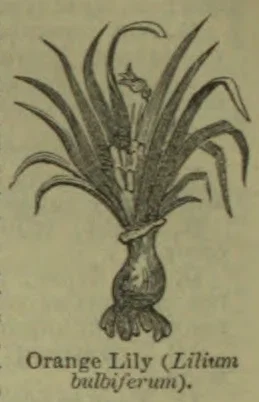
Sense 1. (Bot.) An endogenous, bulbous plant, having a regular perianth of six colored pieces, six stamens, and a superior three-celled ovary. The flowers are generally very showy, and some are very fragrant. The white lily is the Lilium candidum of the East. The American lily is L. Philadelphicum. It is of an orange-red color, spotted on the inside with purple. The yellow lily of the United States is L. Canadense.
Sense 2. That end of a compass-needle which should point to the north;—so called as often ornamented with the figure of a lily or fleur-de-lis.
But sailing further, it veers its lily to the west. Browne.
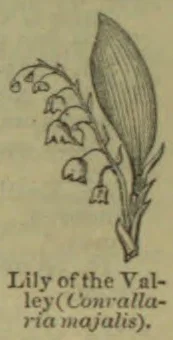
Atamasco lily (Bot.), a plant of the genus Amaryllis (A. Atamasco), having a white and pink, funnel-form perianth, with six petal-like divisions resembling those of a lily. Gray. — Lily daffodil, a plant of the genus Narcissus, and its flower. — Lily encrinite (Paleon.), a fossil zoophyte (Encrinites moniliformis), of the crinoidean family, whose arms, when folded, have some resemblance to a lily-head. Dana. — Lily hyacinth (Bot.), a plant of the genus Hyacinthus. — Lily of the valley, a low, stemless herb (Convallaria majalis), having a raceme of nodding, fragrant flowers; liricon-fancy.