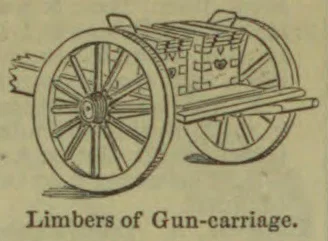
Lim'ber1, a.
a. [Eng. limp, a., q. v.; N. H. Ger. lummer.] Easily bent; flexible; pliant; yielding. “Who have a spirit so limber they can stretch it any whither.” Barrow.
3 entries under this word
a. [Eng. limp, a., q. v.; N. H. Ger. lummer.] Easily bent; flexible; pliant; yielding. “Who have a spirit so limber they can stretch it any whither.” Barrow.
v. t. [imp. & p.p. LIMBERED; p.pr. & vb. n. LIMBERING.] 1. To attach to the limbers; as, to limber the gun; — often with up. 2. [From the adjective.] To cause to become limber; to make flexible or pliant.
Sense 1. (Mil.) That part of a gun-carriage, consisting of two wheels and a shaft, to which the horses are harnessed.
Sense 2. A shaft of a carriage; a thill.
Sense 3. (pl.) (Naut.) Holes cut through the floor timbers, to afford a passage for water to the pump-well;—called also limber-holes.
Limber-boards (Naut.), short pieces of plank forming part of the lining of a ship's floor immediately above the timbers, so as to prevent the limbers from becoming clogged. Buchanan.—Limber-box (Mil.), a box on the limber for carrying ammunition.—Limber-rope, or chain (Naut.), a rope or chain passing through the limbers of a ship, by which they may be cleared of dirt that chokes them. Totten.