3 entries under this word

Lime

Lime, n.

noun

n. [A-S. lim, Icel. lim, Sw. lim, Dan. liim, O. H. Ger. lim, N. H. Ger. leim, D. lijm.] 1. A viscous substance, something laid on twigs for catching birds. Like the lime That foolish birds are caught with. Wordsworth.

  1. (Chem.) Oxide of calcium; the white, caustic substance, usually called quicklime, obtained from limestone, shells, &c., by heat, the heat expelling carbonic acid, and leaving behind the lime.
  2. (Bot.) The linden-tree. See LIND, LINDEN.
  3. A thong by which a dog is led; a leash. Halliwell.
Lime, n.

noun

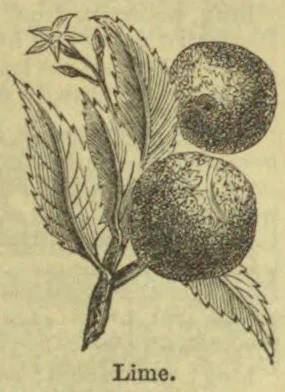
n. [Fr. lime, It. & Sp. lima, from Per. lima, limun. Cf. LEMON.] A fruit allied to the lemon, but smaller, and more intensely sour. It is produced by the Citrus limetta, and found in all warm climates.

A botanical illustration of a lime branch with leaves, a flower, and two fruits.
Lime.

Lime, v. t.

verbtransitive

v. t. [imp. & p. p. LIMED; p. pr. & vb. n. LIMING.] [A-S. liman, geliman, Icel. lima. See supra.]

Sense 1. To smear with a viscous substance.

These twigs, in time, will come to be limed. L'Estrange.

Sense 2. To entangle; to insnare.

We had limed ourselves with open eyes. Tennyson.

Sense 3. To manure with lime.

Land may be improved by draining, marling, and liming. Child.

Sense 4. To cement. “Who gave his blood to lime the stones together.” Shak.