Līne1, n.
n. [Lat. linea, a linen thread, string, line, from linum, flax, lint; It. & Sp. linea, Pg. linha, Pr. ligna, Fr. ligne: hence, N. H. Ger. linie, leine, O. H. Ger. linnâ, linâ, D. linicand lijn, Dan. linie, line, Sw. linie, lina.]
Sense 1. A linen thread or string; a slender cord; a length of twine; as, a fishing-line, a hauling-line, a clothes-line, and the like.
Sense 2. Lint or flax. [Obs.] [Written also linne.] “Garments made of line.” Spenser.
Little he was, and wore a breastplate made of line. Chapman.
Sense 3. A thread-like mark of the pen; an extended stroke, whether straight or crooked.
Sense 4. (Math.) That which has length, but not breadth or thickness.
Sense 5. The exterior limit of a figure; boundary; contour; outline. “Free as thy stroke, yet faultless as thy line.” Pope.
Eden stretched her line From Auran eastward to the royal towers Of great Seleucia. Milton.
Sense 6. A thread-like mark upon the face or the hand; lineament; hence, characteristic mark. “The lines . . . of that religion.” Bp. Taylor.
Though on his brow were graven lines austere. Byron.
He tipples palmistry, and dines On all her fortune-telling lines. Cleaveland.
Sense 7. A straight row; a continued series or rank; as, a line of houses, or of soldiers; a line of barriers.
Unite thy forces and attack their lines. Dryden.
Sense 8. (Print.) A straight row of letters and words; as, a page of thirty lines.
Sense 9. A short letter; a note; as, a line from a friend.
Sense 10. (Poet.) A verse, or the words which form a certain number of feet, according to the measure.
Sense 11. Course of conduct, thought, occupation, or policy, conceived as direction toward an end or object; method of argument; department of industry, trade, or intellectual activity.
He is uncommonly powerful in his own line, but it is not the line of a first-rate man. Coleridge.
Sense 12. A series or succession of progeny or relations, descending from a common progenitor; as, the ascending or descending line; the line of descent; the male line; a line of kings.
Sense 13. A connected series of public conveyances, as a line of stages or steamers; and hence, an established arrangement for forwarding merchandise; as, an express line.
Sense 14. (Geog.) (a.) A circle of latitude or of longitude, as represented on a map. (b.) The equator; — usually called the line, or equinoctial line; as, to cross the line.
Sense 15. (Her.) One of the figures used in armorial bearings to divide the shield into different parts, and to compose different figures.
Sense 16. (Script.) (a.) A measuring-cord.
He marketh it out with a line. Isa. xliv. 13.
(b.) That which is measured by a line or cord; boundary; hence, place of abode.
The lines are fallen unto me in pleasant places; yea, I have a goodly heritage. Ps. xvi. 6.
(c.) Instruction; doctrine.
Their line is gone out through all the earth. Ps. xix. 4.
Sense 17. (Mach.) The proper position or adjustment of parts, not as to design or proportion, but with reference to smooth working; as, the engine is in line or out of line.
Sense 18. (Mil.) The regular infantry of an army, as distinguished from militia, guards, volunteer corps, cavalry, artillery, &c.
Sense 19. (Fort.) (a.) A trench or rampart. (b.) (pl.) Dispositions made to cover extended positions, and presenting a front in but one direction to an enemy.
- One of the divisions of an inch into twelve parts; the twelfth of an inch.
- (Mus.) One of the straight, horizontal, and parallel prolonged strokes on and between which the notes are placed.
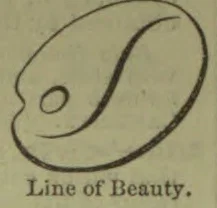
Equinoctial line, the equator of the earth or heavens. See EQUINOCTIAL. — Horizontal line, a line drawn parallel to the horizon. — Line of battle. (a.) (Mil. Tactics.) The position of troops drawn up in their usual order without any determined maneuver. Halleck. (b.) (Naval.) The line or arrangement formed by vessels of war in an engagement. — Line of beauty (Fine Arts), a certain curved line, the extremities of which turn in different directions, giving a form somewhat like that of a very slender, elongated letter S. — Line of defense (Fort.), the line joining a salient angle with the opposite flank. [See Illust. of Ravelin.] — Line of dip (Geol.), a line in the plane of a stratum, or part of a stratum, perpendicular to its intersection with an horizontal plane; the line of greatest inclination of a stratum to the horizon. — Line of fire (Mil.), the direction of fire. — Line of life (Palmistry), a line on the inside of the hand, curving about the base of the thumb, supposed to indicate, by its form or position, the length of a person's life. — Line of march. (Mil.) (a.) Arrangement for marching. (b.) Course or direction taken by an army. — Line of operations, that portion of a theater of war which an army passes over in attaining its object. Halleck. — Meridian line, a meridian. See MERIDIAN. — Right line, a straight line; the shortest line that can be drawn between two points. — Ship of the line, a ship of war large enough to have a place in the line of battle;—called also line-of-battle ship; a vessel superior to a frigate; usually, a seventy-four, or three-decker. Totten.