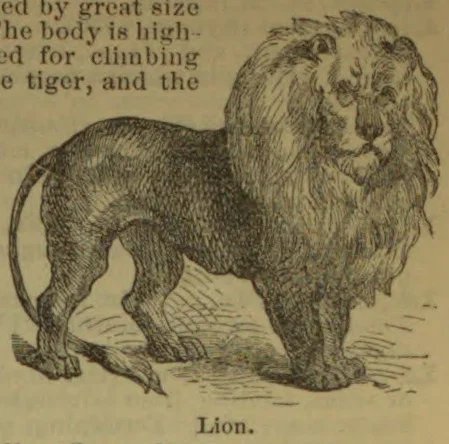
Li'on, n.
n. [Fr. lion, Sp. leon, It. leone, lione, Pr. leo, Lat. leo, leonis, Gr. λέων, A-S. & O. Sax. leo, O. H. Ger. leo, lewo, louwo, N. H. Ger. löwe.]
Sense 1. (Zoöl.) A carnivorous mammal of the genus Leo, characterized by great size and strength. The body is higher and less fitted for climbing than that of the tiger, and the male has usually a thick mane on the neck, and a tail tufted at the end. It is found in Asia, and all over Africa. A variety of the lion, remarkable for having no mane, is found in India.
Sense 2. (Astron.) A sign in the zodiac; Leo. See LEO.
Sense 3. An object of interest and curiosity; as, the lion of the day; to visit the lions of a place.
Such society was far more enjoyable than that of Edinburgh, for here he was not a lion, but a man. Prof. Wilson.
Lion's share, the larger part;—a phrase derived from Esop's fable of the lion, fox, &c., hunting in company, and applied to cases where most of what is gained by parties acting together is taken by the strongest.
☞ Lion is frequently used in the formation of self-explaining compounds; as, lion-eyed, lion-headed, lion-heart, lion-hearted, lion-hunter, lion-mettled, lion-toothed, and the like.