n. A wheel-carriage supporting and driven by a steam-boiler and one or more steam-engines, and used to convey goods or passengers, or to draw wagons or railway cars.
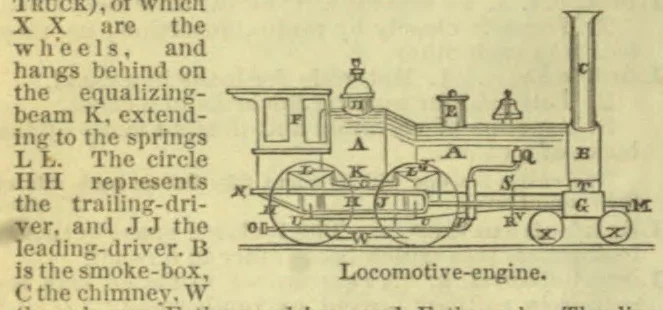
The cut shows the general arrangement of the most common kind. The boiler A A (see Illust. of Boiler), and the engines, of which G is one cylinder, rest on the frame which extends from N to M, and contains the jaws and driving-boxes under the springs L L, as shown. The frame rests in front on the springs of the truck (see Truck), of which X X are the wheels, and hangs behind on the equalizing-beam K, extending to the springs L L. The circle H H represents the trailing-driver, and J J the leading-driver. B is the smoke-box, C the chimney, W the ash-pan, E the sand-box, and F the cab. The line V G represents the piston-rod, U V the connecting rod, and U U the parallel rod. T is the steam-chest, containing the valve, T S the valve-rod, and S R the rocker arms on the rock-shaft. The link-motion (see Link-motion) extends between the forward driving-shaft and the arm R, and, with R S T, forms the valve-gear. See Valve-gear. The pumps (see Illust. of Air-chamber) P draw water from the tender through the feed-pipe O P, and force it into the boiler through the check-valve Q.
Locomotive-engine.