Lōg1, n.
n. [Cf. clog and D. log, heavy, dull; a sense retained in water-logged.]
- A bulky piece or stick of wood or timber.
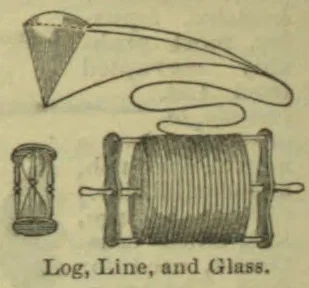
- [L. Ger. log, lock; Dan. log, Sw. logg.] (Naut.) An apparatus for measuring the rate of a ship’s motion through the water.
The common log consists of the log-chip, or log-ship, often exclusively called the log, and the log-line, the former being commonly a thin wooden quadrant of five or six inches’ radius, loaded with lead on the arc to make it float upright, and the latter the line or cord to which it is attached. This line is divided into equal spaces, called knots. When the log is thrown, the log-ship is kept by the water from being drawn forward, and the speed of the ship is shown by the number of knots run out in a given time, as half a minute. Massey’s log is a piece of mechanism, which, being towed astern, shows the distance actually gone through by the ship, by means of the revolutions of a fly, which are registered on a dial-plate. 3. Hence, the record of the rate of a ship’s velocity; a log-book. Rough log, is a first draught, and the smooth log, a copy of the preceding, which is forwarded, after a cruise, to the navy department. Totten. 4. [Heb. lōg, from lāg, to be hollow.] A Hebrew measure of liquids, containing, according to some authors, three quarters of a pint; according to others, five sixths of a pint.