3 entries under this word

Loom

Lōōm, n.

noun

n. [A-S. lōma, gelōma, pl. lōman, household stuff, furniture, vessels, utensils.]

Sense 1. A frame or machine of wood or other material, in which a weaver forms cloth out of thread.

Hector, when he sees Andromache overwhelmed with terror, sends her for consolation to the loom and the distaff. Rambler.

Sense 2. (Naut.) That part of an oar which is within the row-lock. Totten.

Sense 3. The indistinct appearance of any thing, as land, whose outline only is visible. Totten.

Sense 4. A chimney; a lum. [Prov. Eng.] Halliwell.

Loom is used in composition in the word heir-loom. See HEIR-LOOM.

Loom wall, a chimney wall. Fuller.
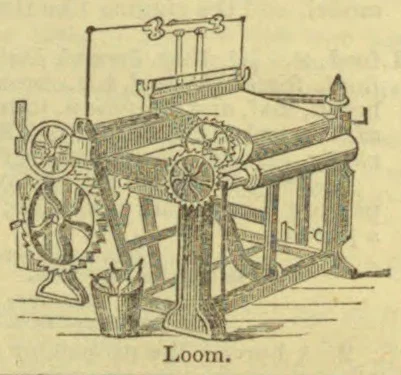
An illustration of a loom with its gears, rollers, and frame.
Loom.

Lōōm, n.

noun

n. See Loon.

Lōōm, v. i.

verbintransitive

v. i. [imp. & p. p. LOOMED; p. pr. & vb. n. LOOMING.] [A-S. leómian, lyman, to shine, leóma, for leōkuma, a beam of light, from an hypothetical A-S. leóhan, Goth. liuhan, equivalent to Lat. lucere.]

  1. To appear above the surface either of sea or land, or to appear larger than the real dimensions, and indistinctly, as a distant object, a ship at sea, or a mountain; as, the ship looms large, or the land looms high.
  2. To rise and to be eminent; to be elevated or ennobled, in a moral sense.

On no occasion does he [Paul] loom so high, and shine so gloriously, as in the context. J. M. Mason.