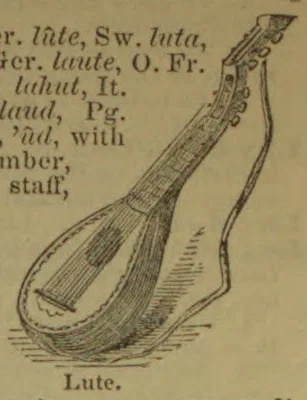
Lūte1, n.
n. [O. D. & M. H. Ger. lūte, Sw. luta, Dan. lut, N. D. luit, N. H. Ger. laute, O. Fr. leut, N. Fr. luth, Pr. laut, lahut, It. liūto, leito, liúdo, Sp. laud, Pg. alaude, from Ar. al’ūd, i. e., ’ūd, with the art. al prefixed, wood, timber, trunk or branch of a tree, staff, stick, wood of aloes, lute or harp.] (Mus.) A stringed instrument formerly much in use. It consists of four parts, namely, the table or front, the body, having nine or ten ribs or sides, arranged like the divisions of a melon, the neck, which has nine or ten stops or divisions, and the head, or cross, in which the screws for tuning are inserted. The strings are struck with the right hand, and with the left the stops are pressed.