Mōl'lusk, n.
n. [Fr. mollusque. See supra.] (Zoöl.) An invertebrate animal, having a soft, fleshy body (whence the name), which is inarticulate, and not radiate internally. See ANIMAL KINGDOM.
There are two subdivisions, the Ordinary and the Anthoid mollusks, the latter the inferior, and each contains three classes.
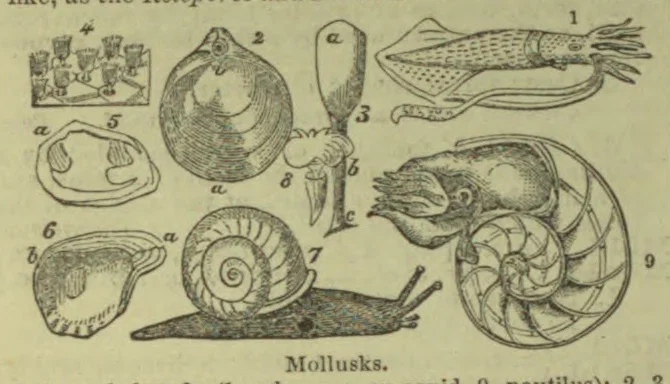
I. ORDINARY MOLLUSKS, having a cephalic and caudal extremity, or the bipolarity characteristic of animal life, and, accordingly, with some exceptions among the lowest species, progressive locomotion. In the bivalve species, or conchifers, the mouth is opposite one extremity of the shell (a, figs. 5 and 6). 1. Cephalopods, having a distinct head with perfect eyes, and a circle of arms around the mouth, some or all of which are adapted for clinging, as in the cuttle-fish or sepia, the squid (fig. 1), and nautilus (fig. 9). 2. Cephalates, having a distinct head with eyes and antennae. This class includes (1) the Gasteropods, which move by crawling on a broad expansion below, as in the snail (fig. 7) and volute; and (2) the Pteropods, which have wing-like expansions for swimming (fig. 8). 3. Acephals, having no distinct projecting head or antennae, and imperfect eyes, when any, as in the oyster (fig. 6), clam, and all ordinary bivalves (fig. 5). The hinge of the shell is dorsal, and one extremity, usually the shorter (a), is the anterior, and the other (b) the posterior. This class includes the Conchifers or Bivalves, also called Lamellibranchs from the lamellar branchiae, or gills.
II. ANTHOID MOLLUSKS, having some similarity in form to a flower, especially a bilabiate or orchis-like flower, and, for the most part, attached, at least when young, by a stem or pedicel. The bivalve species (or Brachiopods) have the stem proceeding from the beak, and the mouth is opposite; and a line between the two divides the shell and its animal into two symmetrical halves. In fig. 3 (a, Lingula), a b is the shell opening upward, b c the stem; in fig. 2 (the shell of a Terebratula), at b is the aperture for the stem, and the mouth is opposite, a. The Ascidians, when compound, are attached in a corresponding manner. The Bryozoans are always attached, and are in general more like regular flowers. 1. Ascidians, having a sac-like shape, and a leathery or membranous exterior, with two openings, one for the entrance and the other for the exit of water, as the ordinary Ascidiae and Salpae. 2. Brachiopods, having a bivalve shell, and a pair of spiral fringed appendages, called arms, situated one either side of the mouth, as the Lingula (fig. 3), Terebratula (fig. 2). 3. Bryozoans, minute animals, having a circle of slender arms around the mouth (fig. 4, showing the head of the animal exsert from its cell), and making delicate corals, sometimes moss-like, as the Retepores and Flustrae. Dana.
Mollusks.
1, 9, cephalopods (1, calamary, or squid, 9, nautilus); 2, 3, brachiopods (2, terebratula, 3, lingula); 4, bryozoan; 5, 6, acephals, or conchifers; 7, 8, cephalates (7, a gasteropod [a snail], 8, a pteropod).