Mŏnk'ey, n.
(mŭnk'ĕ), n.; pl. MŎNK'EYS. [Cf. O. It. monicchio, now monnino, diminutive of monna, an ape, and dame, mistress, contracted from madonna, q. v.; Sp. & Pg. mono, mongous, mongooz, N. Lat. mongus, a kind of monkey in the Island of Madagascar.]
Sense 1. (Zoöl.) One of an order of four-footed mammals, having pectoral mammæ, short legs with hand-shaped prehensile feet, usually, long arms with clasping hands, and almost always a prehensile tail; an ape. The species most nearly resembling man in form, as the orang-outang and gorilla are often called man-apes. Some species resemble man in form and many points of structure. They are natives of the torrid zone.
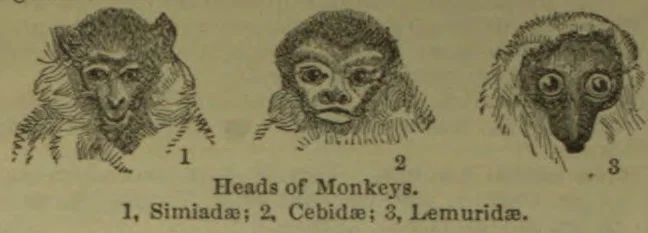
The monkeys are divided into three groups. (a.) Catarrhines, or Simidæ. These have an oblong head, with oblique, flat nostrils, and anterior members longer than the posterior, and provided with distinct thumbs. Some have no tail, as the apes. All these are natives of the old world. (b.) Platyrhines, or Cebidæ. These have a round head, with wide nostrils; the anterior members are usually longer than the posterior, and are without distinct thumbs. All have tails of great length, as the spider-monkey. These are natives of the new world. (c.) Strepsorhines, or Lemuridæ. These have a pointed head, with curved nostril openings; the posterior members are usually the longer; they have a bushy tail. They are mostly nocturnal, have large eyes, and soft wool, as the Lemurs. These are natives of the East Indies and Madagascar.
Heads of Monkeys. 1. Simidæ; 2. Cebidæ; 3. Lemuridæ.
Sense 2. More strictly, the long-tailed individuals of the order.
Sense 3. A name of contempt, or of slight kindness.
Sense 4. The weight of a pile-driver, that is, a very heavy mass of iron, which, being raised on high, descends with great momentum on the head of the pile, and forces it into the earth. Eng. Cyc.