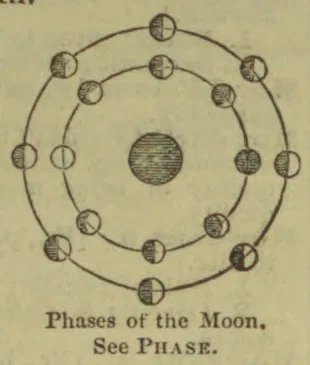
Mōon1, n.
n. [A-S. & O. Fries. môna, O. Sax. & O. H. Ger. môno, Icel. mâni, Dan. maane, Sw. mâne, D. maan, Goth. nêna, M. H. Ger. mâne, mânôt, mânet, mânde, mînede, mônde, mônt, N. H. Ger. mond, allied to Gr. μῆν, Skr. mās, from mā, to measure.]
Sense 1. The heavenly orb which revolves round the earth; the satellite of the earth; a secondary planet, whose light, borrowed from the sun, is reflected to the earth, and serves to dispel the darkness of night. See MONTH.
The moon, Rising in clouded majesty, at length, Apparent queen, unveiled her peerless light, And o'er the dark her silver mantle threw. Milton.
Sense 2. Hence, a secondary planet, or satellite, revolving about any member of the solar system, as the moons of Jupiter.
Sense 3. A month; a revolution of the moon, from new moon to new moon, or full moon to full moon. This is a sense in which rude nations use the name of the moon; as, seven moons.
Sense 4. (Fort.) A crescent-formed outwork. See HALF-MOON.