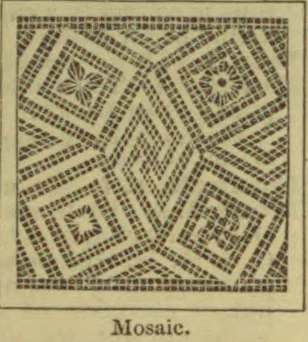
a. Of, or pertaining to the style of work called mosaic; formed by uniting pieces of different colors; variegated; tessellated; also, composed of various materials or ingredients.
Mosaic gold. (a.) A peculiar alloy, composed of from 52 to 55 parts of zinc, and 45 to 48 parts of copper, used for cheap articles of jewelry and ornamental metal-work;—called also or-molu. (b.) The bi-sulphuret of tin in the form of brilliant gold-colored scales, the aurum musivum of the old chemists, known also as bronze powder, and used for ornamental work, as in the manufacture of paper-hangings.—Mosaic wool-work, figured work, analogous to mosaic, wrought in rugs, &c., by arranging colored threads of worsted side by side in a compact mass, so that the desired figures shall appear at the ends or in any transverse section, and then, after a backing of canvas or other material has been cemented by India-rubber to an end section, cutting off transversely a sufficient thickness for the pile or nap, by the repetition of which process many like patterns are successively produced.