Mŭs'çle, n.
(mŭs'sl), n. [Fr. muscle, Pr. muscle, moscle, Sp. & Pg. musculo, It. muscolo, from Lat. musculus, a muscle, and a little mouse, dim. of mus, a mouse; Ger., D., Sw., & Dan. muskel, Gr. μῦς, A-S. & O. H. Ger. mûs, N. H. Ger. maus, mouse and muscle.]
Sense 1. (Anat.) An organ of motion in animal bodies.
☞ Muscles are of two kinds, the voluntary and the involuntary. The former are composed of bundles of parallel, delicate fibers, cylindrical, of a natural reddish tint, and striated longitudinally and transversely. They for the most part act in obedience to the will, and contract suddenly. The involuntary muscles are composed of bundles of spindle-shaped, non-striated fibers, are of a whitish hue, are not obedient to the will, and contract slowly. The voluntary muscles constitute the flesh of animals; the involuntary are found in the stomach, alimentary canal, uterus, bladder, skin, &c.
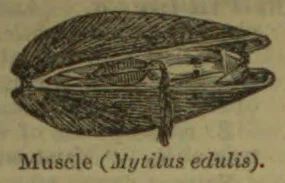
Sense 2. [A-S. muscel, muscle, muscl, muxle, O. H. Ger. muscla, muscula, N. H. Ger. muschel, N. Pr. muscle, Fr. moule, Latin musculus.] (Conch.) A bivalvular shellfish of the genus Mytilus. [Written also mussel.]
Muscle band (Geol.), a stratum of shale, generally ferruginous or calcareous, belonging to the coal formation, and containing great numbers of indurated shells resembling those of the muscle.