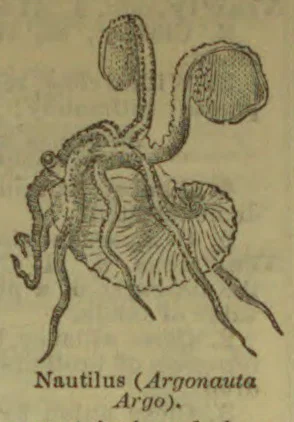
Nau'ti-lūs, n.
n. [Lat. nautilus, from Gr. ναυτίλος, a sea-man, sailor, a kind of shell-fish, furnished with a membrane that serves it as a sail, from ναῦς, ship; It. & Sp. nautilo, Fr. nautile.] (Zoöl.) A genus of small cephalopodous mollusks. The animal has the sac, eyes, parrot-beak, and funnel of the other cephalopods; but its mouth, instead of the large arms and feet, is surrounded by several circles of numerous small tentacles without cups. The shell is a spiral, symmetrical, and chambered shell, that is, divided into several cavities by partitions. Its laminæ cross suddenly, even in the last turns of the spine, which not only touch the preceding ones, but envelop them. The siphon occupies the center of each partition.
The name is also loosely applied, in popular language, to the shells of several different genera of mollusca. The animal which is said to sail in its shell upon the surface of the water, is the Argonauta Argo, very different from the nautilus. Perhaps nautilus may be said to be its poetical name. “Learn of the little nautilus to sail.” Pope.