Nōde, n.
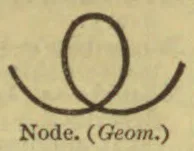
n. [Lat. nodus, It. & Sp. nodo, Fr. nœud.] 1. A knot; a knob; a protuberance; a swelling. 2. Specifically, (a.) (Astron.) One of the two points where the orbit of a planet, or comet, intersects the ecliptic, or the orbit of a satellite intersects that of its primary. (b.) (Bot.) The joint of a stem, or the part whence a leaf, or pair of leaves, springs. Gray. (c.) (Dialing.) A hole in the gnomon of a dial, by the light passing through which the hour of the day, the parallels of the sun’s declination, his place in the ecliptic, and the like, are shown. (d.) (Geom.) The oval figure, or knot, formed by the folding of a curve upon itself. (e.) (Mech.) The point at which the lines of a funicular machine meet from different angular directions. W. R. Johnson. (f.) (Poet.) The knot, intrigue, or plot of a piece, or the chief difficulty. (g.) (Med.) A hard concretion or incrustation which forms around joints attacked with rheumatism or gout; sometimes also other swellings of the joints. Dunglison. (h.) (Mus.) One of the fixed points of a sonorous chord, at which it divides itself, when it vibrates by aliquot parts, and produces the harmonic sounds.
Ascending node (Astron.), the node at which the body is passing northerly, marked with the symbol ☊, called the Dragon’s Head. —Descending node, the node at which the body is moving southwardly, marked thus ☋, called Dragon’s Tail. —Line of nodes, a straight line joining the two nodes of an orbit.