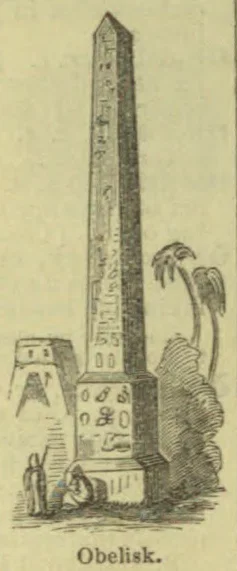
ŏb'e-lisk1, n.
n. [Fr. obélisque; It. & Sp. obelisco, Lat. obeliscus, Gr. ὀβελίσκος, dim. of ὀβελός, a spit, a pointed pillar.]
Sense 1. A tall, four-sided pillar, gradually tapering as it rises, and cut off at the top in the form of a flat pyramid; any pillar, especially one set up in an open square or court. The shaft is properly made of one entire stone, as in the Egyptian obelisk, which are also often charged with inscriptions or hieroglyphics.
Sense 2. (Print.) A reference or mark [thus, †], called also a dagger, used to arrest the attention of the reader, as a reference to notes in the margin or at the bottom of a page, as a mark of censure, or to indicate that a word or expression is obsolete;—the use varying at the pleasure of writers.