Ob-lique'1, a.
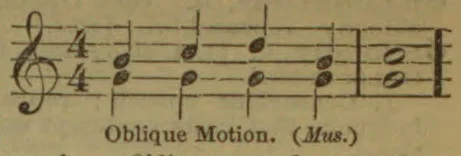
(-leek', or -lik') (Synop., §130), a. [Lat. obliquus, fr. pref. ob and liquis, oblique; Fr. oblique, Pr. oblic, Sp. oblicuo, It. obliquo.] [Written also oblike*.] 1. Not erect or perpendicular; not extending at right angles from the base; slanting; inclined. It has a direction oblique to that of the former motion. Cheyne. 2. Not straight forward; indirect; obscure; hence, sometimes, underhand. This mode of oblique research, when a more direct one is denied, we find to be the only one in our power. De Quincey. 3. Hence, envious; unpropitious. [Rare.] “Oblique Saturn.” Spenser. Then would be closed the restless, oblique eye, That looks for evil, like a treacherous spy. Wordsworth. 4. Not direct in descent; not following the line of father and son; collateral. His natural affection in a direct line was strong, in an oblique line weak. Baker. Oblique angle (Geom.), any angle except a right angle. — Oblique ascension of a celestial body (Astron.), that point of the equinoctial which rises with the body, in an oblique sphere; the point or degree which sets with the body in its oblique descension. [Both terms are obsolete.] — Oblique case (Gram.), any case except the nominative. — Oblique circle (Projection), a circle whose plane is oblique to the axis of the primitive plane. — Oblique cylinder, or cone, one whose axis is oblique to the plane of its base. — Oblique fire (Mil.), a fire the direction of which is not perpendicular to the line fired at. — Oblique leaf (Bot.), one not symmetrical, owing to a twist in the petiole, or inequality between the two sides of the midrib. — Oblique line (Geom.), a line that, falling on another, makes oblique angles with it. — Oblique motion, or oblique (Mus.), a kind of motion or progression in which one part ascends or descends, while the other prolongs or repeats the same tone, as in the accompanying example. — Oblique muscle (Anat.), a muscle either diagonal to the main axis of the body or to its transverse planes. — Oblique planes (Dialing), planes which decline from the zenith, or incline toward the horizon. — Oblique sailing (Naut.), the movement of a ship when she sails upon some rhumb between the four cardinal points, making an oblique angle with the meridian. — Oblique speech (Rhet.), that which is quoted indirectly, or in a different person from that employed by the original speaker. — Oblique sphere (Astron. & Geog.), the celestial or terrestrial sphere when its axis is oblique to the horizon of the place; or its position to an observer at any point on the earth except the poles and the equator. — Oblique system of co-ordinates (Analytical Geom.), a system in which the co-ordinate axes are oblique to each other.