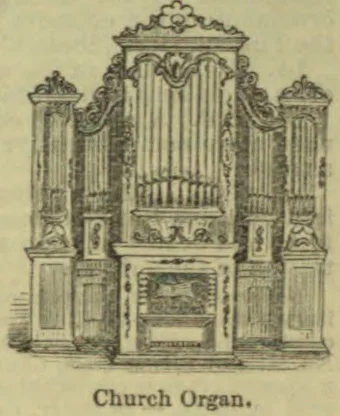
Ōr'gan1, n.
n. [Fr. organe, Sp. & It. organo, Lat. organum, Gr. ὄργανον.]
Sense 1. An instrument or medium by which an important action is performed, or an important object is accomplished; especially, a natural part or feature of a living existence or being, capable of a special function that is essential to the life or well-being of the whole, as the lungs, the heart, &c.; also, an artificial or conventional structure which performs a duty or function that is determined by the nature or the welfare of such an existence; as, the organs of government, law, &c.
Sense 2. A medium of communication between one person or body, and another; as, the secretary of state is the organ of communication between the government and a foreign power.
Sense 3. [A-S. organ, It. & Sp. organo, Pr. & Fr. orgue, Ger. & D. orgel.] (Mus.) A wind-instrument containing numerous pipes of various dimensions and kinds, which are filled with wind from a bellows, and played upon by means of keys similar to those of a piano-forte.
While in more lengthened notes, and slow, The deep, majestic, solemn organs blow. Pope.
Cabinet-organ (Mus.), an organ of small size, resembling the reed organ, but superior to it. — Hand-organ, or barrel organ, an instrument, consisting of a movable turning cylinder, called a barrel, on which, by means of wires, pins, and staples, are set the tunes it is intended to perform. These pins and staples, by the revolution of the barrel, act upon the keys within, and give admission from the bellows to the pipe. Moore. — Organ-point, a passage in which the tonic or dominant is sustained continuously by one part, while the other parts move.