6 entries under this word

Pale

Pāle, a.

adjective

a. [compar. PALER; superl. PALEST.] [Fr. pâle, O. Fr. pale, palle, pasle, Pr. palle, Sp. palido, It. pallido, Lat. pallidus, from pallere, to be or look pale.] 1. Not ruddy or fresh of color; deficient in intensity or energy of color; dusky white; pallid; wan; as, a pale face, a pale red, a pale blue. They are not of complexion red or pale. Randolph. 2. Not bright or brilliant; of a faint luster; dim; as, the pale light of the moon. The night, methinks, is but the daylight sick; It looks a little paler. Shak. Pale is sometimes used in the formation of self-explaining compounds; as, pale-colored, pale-eyed, pale-face, pale-faced, pale-glimmering, pale-hearted, pale-leaved, pale-looking, pale-visaged, and the like.
Pāle, n.

noun

n. Paleness; pallor. [Rare.]

Pāle, v. i.

verbintransitive

v. i. [imp. & p. p. PALED; p. pr. & vb. n. PALING.] To turn pale.

There are men Born tender, apt to pale at a trodden worm. E. B. Browning.

No paling of the cheek of bloom Forewarned us of decay. Whittier.

Pāle, v. t.

verbtransitive

v. t. To make pale.

Pāle, n.

noun

[A-S., Fr., & Pr. pal, from Lat. pālus, It. & Sp. palo; L. Ger. & D. paal, N. H. Ger. pfahl, Dan. pāl, Sw. pāle. Cf. POLE.]

Sense 1. A narrow board, pointed or sharpened at one end, used in fencing or inclosing; a pointed stake driven into the ground and fastened to a rail at the top; a picket.

Sense 2. That which incloses or fences in; an inclosing boundary; a limit; a fence.

Sense 3. Hence, space inclosed; an inclosure; a limited territory or region. “To walk the studious cloister’s pale.” Milton. “Completely out of the pale of civilization.” Macaulay.

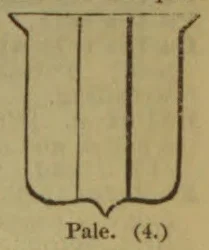
Sense 4. (Her.) One of the greater ordinaries, being a broad, perpendicular stripe in an escutcheon, equally distant from the two edges, and occupying one third of it.

Sense 5. An instrument for ascertaining the quality of cheese; a cheese-scoop. Simmonds.

English pale (Hist.), the limits or territory within which the English conquerors of Ireland held their dominion for a long period after their invasion of the country in 1172. “There is no part but the bare English pale in which the Irish have not the greatest footing.” Spencer.

A heraldic pale is shown as a broad vertical band within a shield-like outline.
Pale. (4.)

Pāle, v. t.

verbtransitive

v. t. [D. paalen, Ger. pfählen.] To inclose with pales or stakes; to inclose; to encompass.

The English beach Pales in the flood with men, with wives, and boys. Shak.