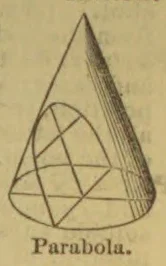
Pā-răb'o-lă, n.
n.; pl. PA-RĂB'O-LĂS. [N. Lat., from Gr. παραβολή;—so called because its axis is parallel to the side of the cone. See supra.] (Geom.) (a.) A curve, one of the conic sections, formed by the intersection of the surface of a cone with a plane parallel to one of its sides. It is a curve, any point of which is equally distant from a fixed point, called the focus, and a fixed straight line, called the directrix. (b.) Any curve having an infinite branch, without having a rectilineal asymptote. Math. Dict.