Pār'al-lel1, a.
a. [Gr. παράλληλος, from παρά, beside, and ἀλλήλων, of one another, Lat. parallelus, Fr. parallele, Pr. paralel, It. parallelo, paralello, Sp. paralelo.]
Sense 1. (Geom.) Extended in the same direction, and in all parts equally distant; as, parallel lines. Parallel Lines.
Sense 2. Having the same direction or tendency; running in accordance with something.
When honor runs parallel with the laws of God and our country, it can not be too much cherished. Addison.
Sense 3. Continuing a resemblance through many particulars; applicable in all essential parts; like; similar; as, a parallel case; a parallel passage.
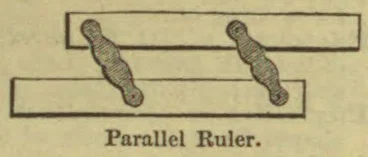
Parallel motion. (a.) (Steam-eng.) A contrivance for connecting the piston and pump-rods with the working beam, so as to convert the circular motion of the beam into the rectilinear motion of the rods, and preserve the parallelism of the rods with the axes of their cylinders. (b.) (Mus.) The ascending or descending of two or more parts in such a manner as to have constantly the same interval between the corresponding notes in the several parts. — Parallel rod (Locomotive Engines), a rod that connects the crank-pins of driving-wheels; — called also coupling rod, in distinction from connecting rod, which is the rod that connects the cross-head with the crank-pin. [See Illust. of Locomotive.] — Parallel ruler, a ruler or instrument for drawing parallel lines, so constructed as to have its successive positions parallel to each other, or consisting of two movable parts, the opposite edges of which are always parallel. — Parallel sailing, sailing on a parallel of latitude. — Parallel sphere (Astron. & Geog.), that position of the sphere in which the circles of daily motion are parallel to the horizon, as to an observer at either pole.