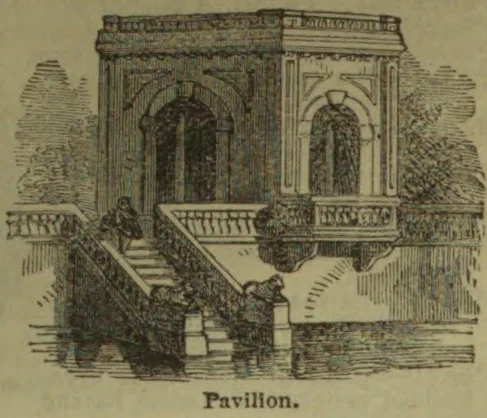
Pa-vil'ion1, n.
(pa-vil'yun), n. [Fr. pavillon, O. Fr. pavellion, Pr. pavalhão, Sp. pabellon, It. padiglione, from Lat. papilio, a butterfly and a tent.]
Sense 1. A temporary movable habitation; a tent.
But, when the old cathedral bell Proclaimed the morning prayer, The white pavilions rose and fell On the alarmed air. Longfellow.
Sense 2. (Arch.) A kind of building or turret, usually insulated and contained under a single roof, sometimes square and sometimes in the form of a dome.—Sometimes a pavilion is a projecting part in the front of a building, and sometimes it flanks a corner. Gwilt.
The name is occasionally, though improperly, given to a summer-house in a garden. Brande.
On the river's brink, I spied a fair pavilion which diffused Its floating umbrage 'mid the silver shade Of osiers. Akenside.
Sense 3. (Mil.) A tent raised on posts.
Sense 4. A flag, colors, ensign, or banner.
Sense 5. (Her.) A covering in form of a tent, investing the armories of kings.
Sense 6. The under side and corner of brilliants, lying between the girdle and collet; — so called by jewelers.
Sense 7. (Anat.) The auricle of the ear; the external ear. Dunglison.