Pēl'ī-can, n.
n. [Lat. pelicanus, pelecanus, Gr. πελε-κάν, πελεκάς, πελικάν, πελε-κάνος, the woodpecker, the joiner-bird, and also a water-bird of the pelican kind, from πελεκάω, to hew with an ax, from πέλεκυς, an ax; Fr. pélican, Pr. pelican, pelica, Sp. & Pg. pelicano, It. pellicano.] [Written also pelecan.]
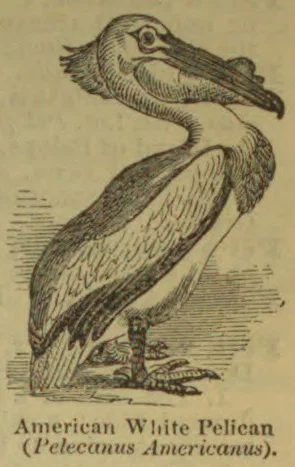
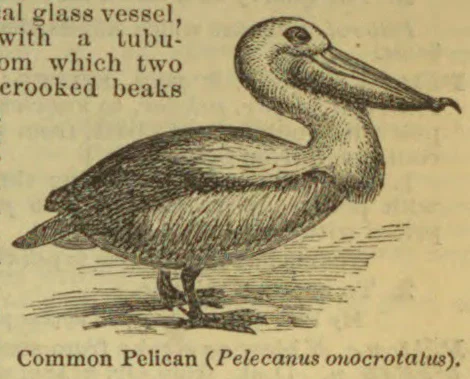
Sense 1. (Ornith.) A web-footed water-fowl of the genus Pelecanus, larger than the swan, and remarkable for its enormous bill, to the lower edge of which is attached a pouch, capable of holding many quarts of water. It is found about the Mediterranean.
Sense 2. A chemical glass vessel, or alembic, with a tubulated head, from which two opposite and crooked beaks pass out, and enter again at the belly of the cucurbit. It is designed for continued distillation and cohobation; the volatile parts of the substance distilling, rising into the capital, and returning through the beaks into the cucurbit. Nicholson.