Pénd'ant, n.
n. [Fr., from pendre, to hang, Lat. pendere.]
Sense 1. Something which hangs or depends; a hanging appendage, especially of an ornamental character; — also, an appendix or addition.
Many . . . distinguished persons . . . have been pleased with this work and its pendant, the Tales and Popular Fictions. Knightley.
Sense 2. An ornament or jewel hanging at the ear; an ear-ring.
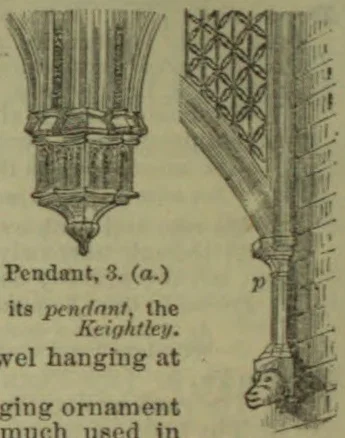
Sense 3. (Arch.) (a.) A hanging ornament on roofs, ceilings, &c., much used in Gothic architecture. (b.) (Mediæval Arch.) A short post placed against the wall, having its lower end supported on a capital, and its upper end supported by a tie-beam; — called also pendant-post. Oxf. Gloss.
Sense 4. A picture or print which, from uniformity of size and subject, hangs as a companion of another. Brande.
Sense 5. (Her.) A part hanging from the label, resembling the drops in the Doric frieze.
Sense 6. A long, narrow piece of bunting, worn at the mast-heads of vessels of war. See PENNANT.
The broad pendant is a square piece, carried in the same way, in a commodore's vessel. Dana.
Sense 7. (Naut.) A rope to which a purchase is hooked.
There are many other pendants consisting of a rope or ropes, to whose lower extremity is attached a block or tackle. The rudder-pendant is a rope made fast to the rudder by a chain, to prevent the loss of the rudder when unshipped. See PENNANT.
Sense 8. A pendulum. [Obs.] Digby.