Pĕnd'ŭ-lŭm, n.
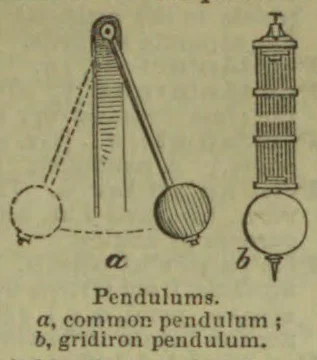
n.; pl. PĔN'D/Ŭ-LŬMṢ. [N. Lat., from pendulus, hanging, swinging; It. pendulo, Sp. pendolo, Fr. pendule. See supra.] A body so suspended from a fixed point as to swing freely to and fro by the alternate action of gravity and momentum; as, the pendulum of a clock.
Ballistic pendulum. See BALLISTIC.—Compensation pendulum, a clock pendulum in which the effect of changes of temperature on the length of the rod is so counteracted, usually by the opposite expansion of different metals, that the distance of the center of oscillation from the center of suspension remains invariable; as, the mercurial compensation pendulum, in which the expansion of the rod is compensated by the opposite expansion of mercury in a jar constituting the bob; the gridiron pendulum, in which compensation is effected by the opposite expansion of sets of rods of different metals.—Conical or revolving pendulum, a weight connected by a rod with a fixed point, and revolving in an horizontal circle about the vertical from that point.—Simple or theoretical pendulum, a pendulum having no dimensions except length, and no weight except at the center of oscillation; or, it is a material point suspended by an ideal line.
Pendulums. a, common pendulum; b, gridiron pendulum.