6 entries under this word

Pile

Pile, n.

noun

n. [Fr. pile, Sp. pila, Pg. pilha, Lat. pila, a ball, globe, pila, a pier or mole of stone; Gr. πῖλος, a ball, globe.]

Sense 1. A mass or collection of things in a roundish or elevated form; a heap; as, a pile of stones, of bricks, of wood, or timber.

Sense 2. A mass regularly formed by rows or layers; a mass designed for a special use, as for burning a corpse.

Sense 3. A large building, or mass of buildings; an edifice.

The pile o'erlooked the town and drew the sight. Dryden.

Sense 4. (Elec.) A vertical series of alternate disks of two dissimilar metals, as copper and zinc, laid up with disks of cloth or paper between them moistened with acid water, for producing a current of electricity;—commonly designated as Volta's pile, the voltaic pile, or the galvanic pile.

☞ The term is sometimes used of any form of apparatus designed to produce a current of dynamic electricity, or as synonymous with battery. It is applied also to an apparatus for generating a current of heat.

Sense 5. A series of iron bars for re-heating.
Pīle, n.

noun

[A-S. pîl, stake, Fr. pile, It., Sp., & Lat. pila, a pillar.]

  1. A large stake or piece of timber, pointed and driven into the earth, as at the bottom of a river, or in a harbor where the ground is soft, for the support of a building or other superstructure.
  2. One side of a coin; originally, a punch or puncheon used in stamping figures on coins, and containing the figures to be impressed. Hence, the arms side of a coin is called the pile, and the head the cross, which was formerly in the place of the head.
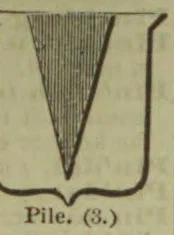
  3. (Her.) One of the lesser ordinaries, having the form of a wedge, usually placed pale-wise, with the broadest end uppermost, resembling a pile used in laying the foundations of buildings in watery places, whence it has its name.

Cross and pile. See CROSS.

A tapered, vertically shaded pile is shown inside a U-shaped outline.
Pile. (3.)

Pīle, n.

noun

n. [D. pyl, L. Ger. piel, O. H. Ger. pfil, N. H. Ger. pfeil, Dan. & Sw. pil, Icel. pîla, arrow, dart, Lat. pilum, javelin.] The head of an arrow. [Obs.] Even till the pile did rest Upon the bosom of the bow. Chapman.

Pīle, n.

noun

n. [Lat. pilus, hair, O. Fr. peil, poil.] A hair; hence, the fiber of wool, cotton, and the like; hence, also, the nap; the fine hairy substance of the surface of cloth, carpeting, velvet, &c.

Pīle, v. t.

verbtransitive

[imp. & p. p. PILED; p. pr. & vb. n. PILING.]

  1. To lay or throw into a pile or heap; to heap up; to collect into a mass; as, to pile wood or stones; to bring into an aggregate; to accumulate; as, to pile quotations or comments. “The labor of an age in piled stones.” Milton.
  2. To fill above the brim or top.
  3. To break off the awns of, as of thrashed barley. [Prov. Eng.]
  4. To furnish or fill with piles; to drive piles in.

To sheet pile, to drive a piling of planks edge to edge in; to place sheet-piling in. See PILING.—To pile arms or muskets (Mil.), to place three guns together in such a manner that they may stand upright steadily. Syn.—To heap; accumulate; amass.

Pīle, v. i.

verbintransitive

v. i. [imp. & p. p. PULED; p. pr. & vb. n. PULING.] [Fr. piauler, It. pigolare, Lat. pipilare, from pipire, to peep, pip, chirp.] 1. To cry like a chicken. Bacon. 2. To cry, as a complaining child; to whimper; to whine. It ill becomes such a gallant to whine and pule. Barrow.