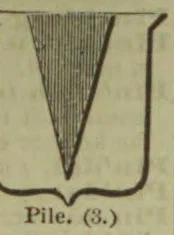
Pile1, n.
n. [Fr. pile, Sp. pila, Pg. pilha, Lat. pila, a ball, globe, pila, a pier or mole of stone; Gr. πῖλος, a ball, globe.]
Sense 1. A mass or collection of things in a roundish or elevated form; a heap; as, a pile of stones, of bricks, of wood, or timber.
Sense 2. A mass regularly formed by rows or layers; a mass designed for a special use, as for burning a corpse.
Sense 3. A large building, or mass of buildings; an edifice.
The pile o'erlooked the town and drew the sight. Dryden.
Sense 4. (Elec.) A vertical series of alternate disks of two dissimilar metals, as copper and zinc, laid up with disks of cloth or paper between them moistened with acid water, for producing a current of electricity;—commonly designated as Volta's pile, the voltaic pile, or the galvanic pile.
☞ The term is sometimes used of any form of apparatus designed to produce a current of dynamic electricity, or as synonymous with battery. It is applied also to an apparatus for generating a current of heat.
Sense 5. A series of iron bars for re-heating.