Pin'ion1, n.
(pĭn'yun), n. [Norm. Fr. pignon, a pen, Sp. pinon, pinion, Pr. pinho, Prov. Fr. pinon, from Lat. pinna, penna, feather, wing.]
Sense 1. A feather; a quill. Shak.
Sense 2. A wing.
Hope humbly then, on trembling pinions soar. Pope.
Sense 3. The joint of a bird's wing most remote from the body.
Sense 4. A fetter or band for the arm. Ainsworth.
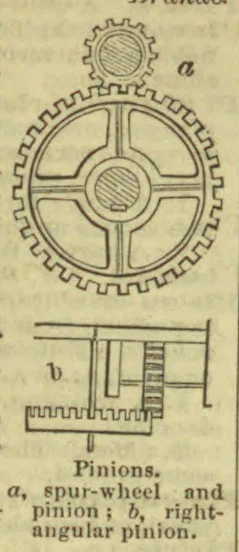
Sense 5. A smaller wheel with leaves or teeth working into the teeth of a larger wheel or rack; especially, such a wheel having its leaves formed of the substance of the arbor or spindle on which it turns; a toothed arbor.
Pinions. a, spur-wheel and pinion; b, right-angular pinion.
Pinion wire, wire fluted longitudinally, for making the pinions of clocks and watches. It is formed by being drawn through holes of the shape required for the leaves or teeth of the pinions.