n. [O. Fr. pic, high place. See PEAK.]
1. A point or peak; hence, any point or degree of elevation or depression; as, a high pitch; lowest pitch. “The lowest pitch of abject fortune.” Milton.
How high a pitch his resolution soars! Shak.
Alcibiades was one of the best orators of his age, notwithstanding he lived when learning was at its highest pitch. Addison.
- Highest attainable point or degree. [Obs.] “Boniface the Third, in whom was the pitch of pride and height of aspiring haughtiness.” Fuller.
- (Mus.) The degree of elevation of the voice, or of an instrument, &c.; the elevation of the key-note of a tune.
Musical tones, with reference to absolute pitch, are named after the first seven letters of the alphabet; with reference to relative pitch, in a series of tones called the scale, they are called one, two, three, four, five, six, seven, eight. Eight is also one of a new scale an octave higher, as one is eight of a scale an octave lower.
4. Height; stature. [Obs.]
So like in person, garb, and pitch. Hudibras.
5. Degree; rate; position.
I can not conceive how any man can have brought himself to that pitch of presumption to consider his country but “carte blanche,” upon which he may scribble whatever he pleases. Burke.
- The point where a declivity begins; hence, the declivity itself; the degree of descent; a descending slope; descent; slope; as, there was a steep pitch in the road; the pitch of a hill.
- A descent; a fall; a thrusting down.
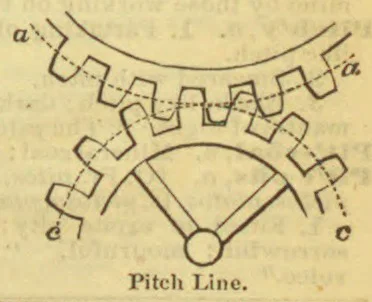
- (Mech.) (a.) The distance from center to center of any two adjacent teeth of gearing, measured on the pitch-line. (b.) The distance measured on a line parallel to the axis, between two adjacent threads or convolutions of a screw. (c.) The distance between the centers of holes, as of rivet-holes in boiler plates.
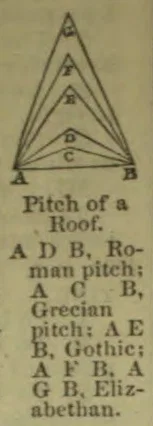
Pitch line, or pitch circle (Gearing), a circle concentric with the circumference of a toothed wheel, and cutting its teeth at such a distance from their points as to touch the corresponding circle of the gear working with it, and have, with that circle, a common velocity, as in rolling contact; the line or circle on which the pitch of teeth is measured. — Pitch of a roof (Arch.), the inclination or slope of the sides; — usually expressed by the height in parts of the span, as a quarter-pitch, one-fifth pitch, whole pitch, &c.; sometimes by the length of the rafters in parts of the span, as two-thirds pitch, three-quarters pitch, &c.; or in degrees, as a pitch of 45°; equilateral pitch, or Gothic pitch, that in which the rafters equal the span, as, A E B; knife-edge or Elizabethan pitch, that in which the rafters are longer than the span, as, A F B, A G B; Grecian pitch, a pitch in which the height is one ninth to one seventh of the span, or the angle from 12° to 16°, as, A C B; Roman pitch, that in which the height is one fifth to two ninths of the span, or the angle 23° or 24°, as, A D B. — Pitch of a saw, the slope of the face of the teeth.
Pitch Line.
Pitch of a Roof. A B, Roman pitch; A C B, Grecian pitch; A E B, Gothic; A F B.