3 entries under this word

Plane

Plāne, a.

adjective

[Lat. planus, Fr. plain, plan, Pr. plan. See PLAIN, a.] Without elevations or depressions; even; level; flat; pertaining to, lying in, or constituting a plane; as, a plane surface.

Plane angle, the angle included between two straight lines in a plane. — Plane chart, a chart in which parallels of latitude and longitude are represented by parallel and equidistant straight lines, in all latitudes. — Plane curve, a curve, all points of which lie in the same plane. — Plane figure, a plane terminated every where by lines. If the lines are straight, it is a rectilinear plane figure; if curved, a curvilinear plane figure. — Plane geometry, that part of geometry which treats of the relations and properties of plane figures. — Plane problem, a problem which can be solved geometrically, by the aid of the right line and circle only. — Plane sailing (Navigation), the method of computing a ship's place and path, on the supposition that the earth's surface is a plane. — Plane scale, a scale for the use of navigators, on which are graduated chords, sines, tangents, secants, rhumbs, geographical miles, &c. — Plane surveying, surveying in which the curvature of the earth is disregarded; ordinary field and topographical surveying of tracts of moderate extent. — Plane table, a table or board mounted on a tripod, and graduated at its edge, with a movable rule to which sights are attached, used for plotting the lines of a survey on paper in the field, without the necessity of taking field-notes. — Plane trigonometry, that part of trigonometry which treats of the relations and properties of the sides and angles of plane triangles. Math. Dict.
Plāne, n.

noun

n. [See supra.] 1. (Geom.) A surface, real or imaginary, in which if any two points are taken, the straight line which joins them lies wholly in that surface; or a surface, any section of which, by a like surface, is a straight line.

  1. (Astron.) An ideal surface, or geometrical plane, conceived as coinciding with, or containing, some designated astronomical line, circle, or other curve; as, the plane of an orbit; the plane of the ecliptic, or of the equator.
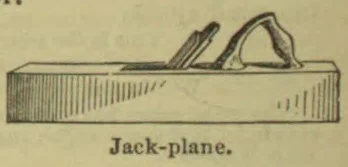
  2. (Joinery.) A tool for smoothing boards or other surfaces of wood, forming moldings, and the like, consisting of a stock, usually of wood, from the under side, face, or sole of which projects, slightly, the steel cutting-edge of the iron, or chisel, which inclines backward, and has an aperture in front for the escape of shavings.

Objective plane (Surv.), the horizontal plane upon which the object which is to be delineated, or whose place is to be determined, is supposed to stand. — Perspective plane. See PERSPECTIVE. — Plane of a dial, the plane upon which the lines marking the hours are drawn. Math. Dict. — Plane of projection. (a.) (Spherical Projections.) The plane on which the projection is made, corresponding to the perspective plane in perspective; — called also principal plane. (b.) (Descriptive Geom.) One of the planes to which points are referred for the purpose of determining their relative position in space. — Plane of refraction or reflection (Opt.), the plane in which lie the incident and also the refracted or reflected ray.

An illustration of a jack-plane, a woodworking hand plane.
Jack-plane.

Plāne, v. t.

verbtransitive

v. t. [imp. & p. p. PLANED; p. pr. & vb. n. PLANING.] [Fr. planer, Pr. & O. Sp. planar, It. pianare, Lat. planare, fr. planus. See PLANE, a., and PLAIN, a.] To make smooth; to pare off the inequalities of the surface of, as of a board or other piece of wood, by the use of a plane; to free from inequalities of surface.